25 min read
California Senate Bill 707: Open Meeting and Teleconferencing Requirements.
Brian McGlynn : Jun 9, 2026 2:54:45 PM
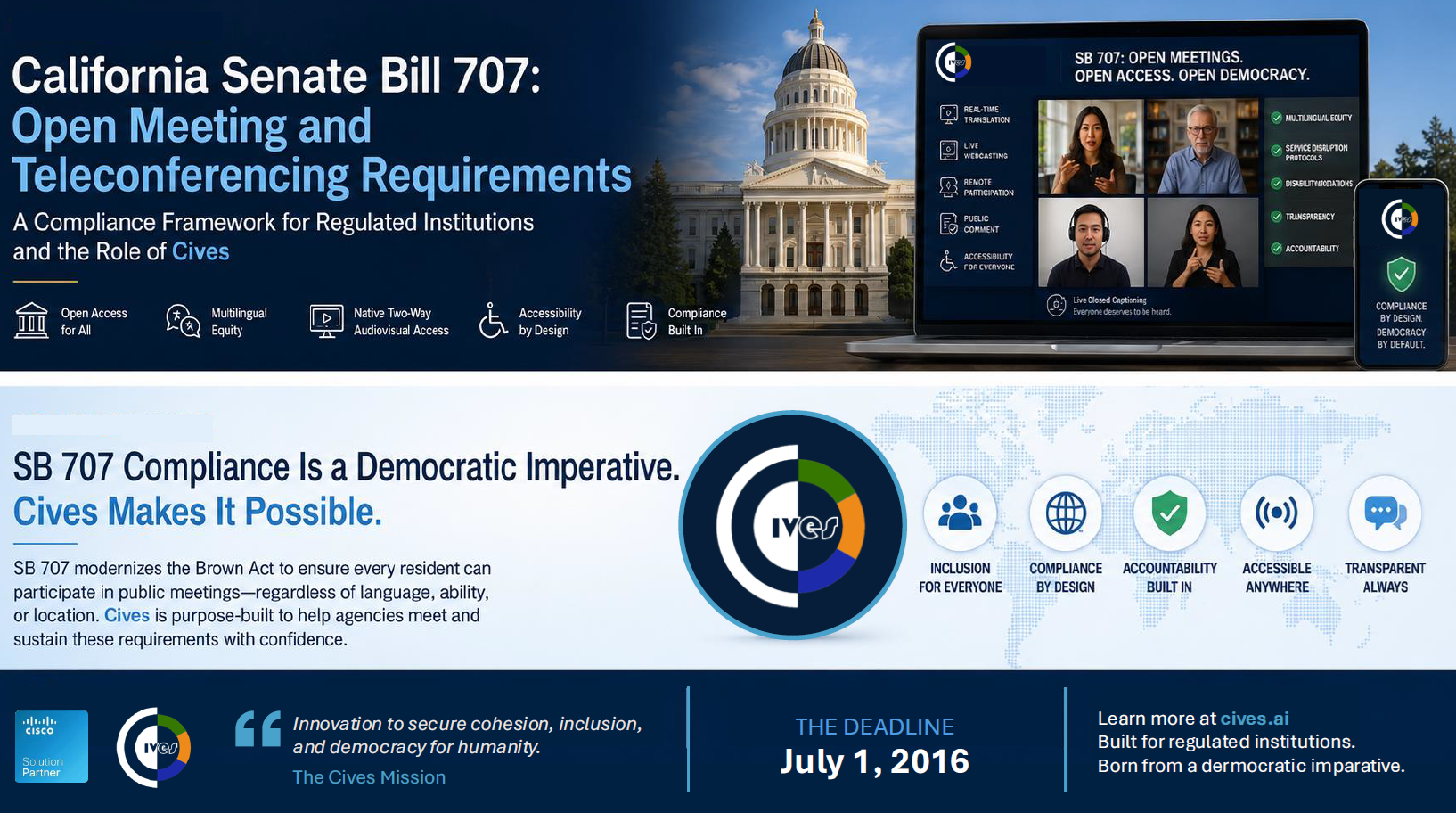
A Compliance Framework for Regulated Institutions and the Role of Cives
Abstract
California Senate Bill 707 (SB 707), signed into law by Governor Gavin Newsom on October 3, 2025, represents the most significant modernization of the Ralph M. Brown Act in its history. The legislation imposes sweeping new requirements on eligible local government bodies regarding public accessibility, audiovisual teleconferencing, multilingual equity, service disruption protocols, and community outreach — effective July 1, 2026. This article examines the legislative history and substantive requirements of SB 707, frames them within the global democratic imperative that animates the Cives platform, and demonstrates how Cives — purpose-built for civic and regulated institutions — provides the infrastructure necessary to achieve and sustain compliance. Unlike general-purpose enterprise video conferencing tools, Cives integrates Brown Act-specific workflows, audit capabilities, and language equity features at the architectural level, creating a compliance solution that generic platforms cannot replicate without fundamental re-engineering.
1. Cives — A Platform Born from a Democratic Imperative
1.1 The Etymology and Mission of Cives
The word cives is the Latin plural of civis — citizen. In the political philosophy of the Roman Republic, the civis was not merely a subject of the state but an active participant in its governance, endowed with rights, obligations, and voice. The concept of citizenship carried within it a radical proposition: that political authority derives from the people, and that every person deserving of the title cives is entitled to be heard, to deliberate, and to hold their representatives accountable.
It is this classical foundation that animates the Cives platform. Founded on the conviction that democracy is not a destination but a continuous practice, Cives was conceived as a technological answer to one of the defining failures of the modern era: the erosion of inclusive civic participation. The platform's guiding obsession is captured in its founding principle — innovation to secure cohesion, inclusion, and democracy for humanity. Not for some citizens. Not for the technologically literate. Not for those who speak the majority language. For every world citizen.
This is not merely a mission statement. It is an architectural commitment. Every feature, every workflow, every compliance module within the Cives platform is designed from the premise that any person — regardless of language, disability, geography, or digital fluency — should be granted the same rights and opportunities to participate in the governance processes that shape their lives.
1.2 The Global Context: Democratic Fragility and Technological Exclusion
The global democratic recession of the early twenty-first century has been well-documented by political scientists and international observers, reporting consecutive years of declining democratic indicators across both established and emerging democracies. Among the most persistent and underappreciated drivers of this decline is the structural exclusion of marginalized communities from civic participation — exclusion that is not always deliberate, but that is often technologically mediated.
As local governments increasingly rely on digital platforms for public meetings, the design choices embedded in those platforms carry profound democratic consequences. A meeting conducted on a platform that lacks real-time translation excludes non-English speakers. A platform with no accessible interface excludes citizens with disabilities. A system that lacks a structured public comment mechanism effectively silences those who do not know to call in or raise their hand at the right moment. These are not edge cases — they are systemic failures that compound existing inequalities.
Cives was founded precisely to disrupt this dynamic. By building technology that treats regulatory compliance not as a constraint to be managed but as a design principle to be embedded, Cives aligns commercial incentives with democratic outcomes. When a local government agency deploys Cives, it is not merely purchasing software — it is adopting a civic infrastructure that embodies the principle that every voice counts.
This democratic imperative extends beyond open meeting compliance. In April 2024, the United States Department of Justice finalized its landmark rule under Title II of the Americans with Disabilities Act (ADA), requiring state and local governments to bring their web content and mobile applications into conformance with WCAG 2.1 Level AA — with extended compliance deadlines running to April 2027 and 2028 respectively. The Cives platform is designed and maintained to exceed this standard, achieving full conformance with WCAG 2.2 Level AA across all public-facing interfaces. This is not a parallel compliance track — it is the same foundational commitment expressed in a different legal register. Where SB 707 demands that every resident be able to participate in public meetings regardless of their geography or language, the ADA demands that every citizen be able to access digital government services regardless of their disability. Cives treats both as expressions of the same non-negotiable principle: that the digital infrastructure of democratic life must be designed for every civis, without exception.
1.3 Purpose-Built for Regulated Institutions
The commercial technology market is dominated by general-purpose collaboration platforms that were designed for enterprise productivity. Their architecture reflects the priorities of their primary customers: corporate efficiency, scalability, and integration with business workflows. These platforms are not defective; they are simply designed for a different purpose.
Regulated institutions — city councils, county boards of supervisors, school boards, special districts, public commissions, and similar bodies — operate under a fundamentally different set of constraints. They are governed by open meeting laws, public records statutes, accessibility mandates, language equity requirements, and democratic accountability norms that have no equivalent in the corporate world. When these institutions attempt to use general-purpose tools to satisfy legally mandated workflows, they inevitably encounter a structural mismatch: the tool was not designed for this purpose, and adaptation is costly, fragile, and often insufficient.
Cives was purpose-built to eliminate this mismatch. Its architecture, from its core meeting management engine to its audit and compliance layer, reflects the specific requirements of regulated institutions. This is not a surface-level feature set — it is a foundational design philosophy that manifests in every dimension of the platform.
2. The Ralph M. Brown Act — Historical and Legislative Context
2.1 Origins and Foundational Principles
The Ralph M. Brown Act was enacted by the California Legislature in 1953, named for Assemblyman Ralph M. Brown of Modesto, who championed open government as a cornerstone of democratic accountability. The Act established the foundational principle that the public's business must be conducted in public — that deliberations of local government bodies are not the private province of elected officials but belong to the citizens they serve.
The Act codified in Government Code section 54950 et seq. the requirement that all meetings of a legislative body of a local agency be open and public, and that all persons be permitted to attend and participate. This commitment to transparency was radical in its simplicity and sweeping in its implications. It recognized that democracy is not self-executing — that formal election of representatives is insufficient if those representatives can then deliberate in secret, beyond the scrutiny and input of their constituents.
Over seven decades, the Brown Act has been amended numerous times to address evolving technological and social conditions. The rise of serial meetings, email deliberations, and social media communication each prompted legislative responses. The COVID-19 pandemic forced an emergency reckoning with remote participation, producing a series of executive orders and temporary legislative accommodations that revealed both the possibilities and the perils of teleconferenced governance.
2.2 The Road to SB 707: Post-Pandemic Reform
The pandemic-era teleconferencing accommodations, originally enacted as emergency measures, were subsequently extended multiple times as the Legislature grappled with how to permanently modernize the Brown Act's framework. The temporary provisions — which allowed members to participate remotely without the traditional location and quorum requirements — expired on a rolling basis and created significant uncertainty for local agencies attempting to plan their meeting operations.
Senate Bill 707, authored by Senator Maria Elena Durazo and signed by Governor Gavin Newsom on October 3, 2025 as Chapter 327, Statutes of 2025, resolved this uncertainty with comprehensive, permanent reform. The legislation both restored provisions set to expire in 2026, made permanent certain transparency-related reforms, and established new affirmative requirements to enlarge public access and participation in local government proceedings.
The bill's passage reflected a bipartisan recognition that the pandemic had demonstrated the viability and desirability of hybrid and remote meeting formats, while also exposing persistent inequities in public participation that technology could either exacerbate or remedy. SB 707 sought to ensure that the latter outcome prevailed.
3. SB 707 — Substantive Requirements and Compliance Obligations
3.1 Scope of Application: Eligible Legislative Bodies
SB 707 creates a two-tiered compliance framework. The baseline provisions of the Brown Act continue to apply to all legislative bodies of local agencies. However, SB 707's most significant new requirements are addressed to a defined category of "eligible legislative bodies," which include:
-
City councils of cities with populations of 30,000 or more;
-
County boards of supervisors of counties with populations of 30,000 or more;
-
City councils located within counties with populations of 600,000 or more;
-
Boards of directors of special districts meeting specified thresholds — including those with over 1,000 full-time employees, those with over 200 full-time employees and annual revenues exceeding $400 million (inflation-adjusted from January 1, 2027), or those covering an entire county of 600,000 or more residents with over 200 full-time employees and a website.
Notably, the current statutory definition of eligible legislative body does not include school districts, though school boards remain subject to the baseline Brown Act requirements. It is worth noting that while the most significant new requirements for eligible legislative bodies take effect on July 1, 2026, several provisions of SB 707 applying to all local agency legislative bodies — including the permanent social media interaction rule and the updated remote participation framework — took effect on January 1, 2026.
3.2 Mandatory Audiovisual Teleconferencing Access
Effective July 1, 2026, and continuing through December 31, 2029, eligible legislative bodies are required to provide members of the public with the ability to attend all open and public meetings via a two-way telephonic service or a two-way audiovisual platform. This mandate is not merely permissive — it is a floor requirement that applies to every open meeting, not just those that the body elects to hold in a hybrid or remote format.
The legislation further requires that the public-facing teleconferencing access be genuinely interactive — not merely a one-way webcast or passive observation channel. The legislative history of SB 707 reflects an explicit rejection of the notion that watching a meeting stream constitutes meaningful participation. The two-way requirement ensures that members of the public retain their right to address the legislative body even if they cannot physically attend.
Importantly, SB 707 redefines "teleconference" to exclude situations where members only watch or listen through non-interactive media. This definitional change has significant implications for compliance: agencies cannot satisfy the audiovisual access requirement through existing webcast-only solutions, but must ensure that the platform they use provides genuine bidirectional communication capability.
A traditional dial-in telephone line satisfies the two-way requirement provided it is genuinely interactive — callers must be able to speak and be heard, not merely listen. The law does not require agencies to offer both telephone and video access simultaneously; a single qualifying channel is sufficient. However, agencies that provide only a video link risk structural exclusion of residents without reliable broadband access, creating participation gaps that run counter to SB 707’s broader equity provisions. Phone participants carry the same substantive rights as video participants: they must be able to address the legislative body during public comment, their participation must be managed on a non-discriminatory basis, and the record of their participation must be preserved in the meeting archive. The statute creates no hierarchy of participation modalities — the mode of access is immaterial provided the opportunity to be heard is genuinely equivalent.
3.3 Service Disruption Policy and Recess Protocol
Among the most operationally specific requirements of SB 707 is the mandate that each eligible legislative body adopt, at a noticed public meeting in open session before July 1, 2026, a written policy for responding to disruptions in telephonic or internet service. The policy must address the circumstances under which the body will recess an open meeting when a disruption prevents members of the public from attending or observing the session.
In the event of a qualifying disruption, the body is required to recess its open session and make a good-faith effort to restore service. The session must remain in recess for at least one hour, or until the disruption has been addressed, whichever is earlier. This one-hour minimum recess requirement is not a suggestion — it is a statutory obligation that creates real compliance risk if the body resumes prior to either the one-hour mark or the restoration of service.
3.4 Multilingual Agenda Translation
Perhaps the most powerful equity provision in SB 707 is the requirement that eligible legislative bodies translate their required meeting agendas, and the public meeting webpages on which they post those agendas, into all "applicable languages." The statute defines applicable languages as those spoken by at least 20 percent of the local population that speaks English less than "very well," as determined by the most recent American Community Survey data.
This threshold-based definition ensures that the translation requirement is calibrated to actual community demographics rather than applying a uniform national standard. In jurisdictions with large Spanish-speaking populations, translation into Spanish will be required. In jurisdictions with significant Vietnamese, Chinese, Tagalog, or Korean-speaking communities, translation into those languages will be necessary. The requirement is dynamic — as demographics change, so do the applicable languages.
Starting July 1, 2026, and continuing through July 1, 2030, this translation requirement applies at the time the agenda is posted with the required 72-hour advance notice. This means that translation cannot be an afterthought — it must be integrated into the agenda preparation and publication workflow.
3.5 Community Outreach and Participation Equity
SB 707 requires eligible legislative bodies to take reasonable steps to encourage participation by residents who have not traditionally engaged in public meetings. This affirmative outreach obligation includes, among other things, outreach to community-based organizations and non-English-speaking organizations, and ensuring that requests for agendas and documents can be made electronically.
The Legislature recognized that even a perfectly accessible meeting platform is insufficient if residents who would benefit from participation are unaware of the meeting, unable to navigate the request process, or disconnected from the institutions of local government. The outreach requirement thus addresses the upstream barriers to participation that infrastructure alone cannot solve.
3.6 Alternative Teleconferencing Framework (Sections 54953.8 et seq.)
SB 707 substantially reorganizes and expands the Brown Act's teleconferencing framework through the addition of new Government Code sections 54953.8 through 54953.8.7. These provisions create a unified and expanded structure for remote participation that applies to all legislative bodies — not just eligible legislative bodies — as an alternative to the traditional teleconferencing rules.
Under the traditional teleconferencing rules (Section 54953), a quorum of the legislative body must be physically present within the jurisdictional boundaries of the agency, and each teleconference location must be publicly accessible. The new alternative framework under Section 54953.8 authorizes teleconferencing without these traditional quorum and location requirements under specified circumstances, including an expanded list of "just cause" grounds permitting remote participation — including childcare responsibilities, illness, family medical emergencies, or military service.
Subsidiary bodies and multijurisdictional bodies are addressed by separate provisions (Sections 54953.8.6 and 54953.8.7) that impose additional requirements, including the designation of at least one physical location within the jurisdiction's boundaries where the public can attend and observe.
3.7 Disability Accommodations and Accessibility
SB 707 makes permanent the accommodation allowing members of a legislative body with disabilities to participate remotely as a reasonable accommodation. These members must participate using both audio and video technology unless their specific disability requires an exception. They must also disclose, at the time of participation, whether any other individuals over the age of eighteen are present at their remote location, and the general nature of their relationship to those individuals.
Participation under this accommodation is deemed equivalent to in-person attendance for all legal purposes, including quorum determination. This provision codifies and makes permanent a framework that had previously operated under temporary executive orders and informal guidance.
3.8 Decorum, Disruption Management, and Enforcement
Through new Government Code section 54957.96, SB 707 expressly affirms that local agencies may remove or restrict the participation of individuals engaging in disruptive behavior during teleconferenced or hybrid meetings. This provision brings the authority of presiding officers over virtual meetings into alignment with their longstanding authority over in-person sessions, ensuring that the orderly conduct of public meetings can be maintained regardless of the participation modality.
The provision is particularly significant in the context of increased harassment and disruption of public meetings — a phenomenon that has become more prevalent in the post-pandemic environment as civic discourse has grown more polarized. SB 707 ensures that agencies have a clear legal basis for removing disruptive participants without creating due process complications, provided they apply consistent, content-neutral standards.
4. The Cives Compliance Architecture for SB 707
4.1 Why Generic Tools Fall Short
Before examining the specific features of the Cives platform, it is worth interrogating why general-purpose enterprise video conferencing tools — tools that are technically capable of supporting a video meeting — are inadequate for Brown Act compliance.
The answer lies in the distinction between capability and architecture. A general-purpose video platform can, in principle, be configured to support a two-way meeting. A staff member can manually translate an agenda using a third-party service. A presiding officer can manually track which members are attending remotely and under what authority. These workarounds can achieve a degree of compliance, but they are fragile, labor-intensive, and audit-incomplete.
More fundamentally, they miss the point. SB 707 does not merely require that certain activities occur — it requires that they occur in a documented, accountable, and institutionally reliable manner. A meeting with a manually configured waiting room is not the same as a purpose-built platform that automatically enforces the two-way participation requirement, records the legal authority for each remote participant's attendance, manages the disruption-and-recess workflow, and generates an audit trail that satisfies the Brown Act's record-keeping obligations.
The compliance gap is not a matter of features — it is a matter of architecture. Generic tools were not designed to enforce regulatory workflows; they were designed to facilitate communication. Cives was designed to do both simultaneously, in a manner that reduces compliance risk rather than displacing it onto human operators.
Among the general-purpose video platforms that have been adapted for civic meeting use, some have invested more than others in configurations and features designed to address Brown Act requirements. It would be inaccurate to suggest that all such platforms are equally inadequate — some offer speaker queue management, interpretation channels, and phone bridge capabilities that represent genuine improvements over an unconfigured baseline. The question for compliance purposes, however, is not whether an adapted platform is better than nothing. It is whether the adaptations are architecturally sufficient to satisfy SB 707’s requirements in a legally defensible and operationally reliable manner. On that test, the structural limitations of the adapted platform model become clear.
Consider speaker queue management. An adapted platform may sort raised-hand requests chronologically, which represents an improvement over alphabetical or arbitrary ordering. But chronological sorting is a display feature, not an enforcement mechanism. The presiding officer retains discretionary control over who speaks and when, and there is no automated record of whether the queue was observed in the order presented. In a Brown Act challenge alleging discriminatory management of public comment, the absence of an enforced, documented queue is a material evidentiary gap that a display feature cannot close.
Consider phone caller identification. An adapted platform may allow a meeting clerk to manually rename a phone participant’s display label during the session — replacing a generic “Caller 7” designation with the speaker’s stated name. This is useful for in-session record-keeping, but it does not constitute a legally defensible audit trail. The rename is a manual action by a staff member; it is not verified, not time-stamped at the point of identification, not linked to the specific agenda item being addressed, and not integrated into a post-session compliance archive. Under SB 707’s minutes documentation requirements, this level of record-keeping is insufficient.
Consider simultaneous interpretation. SB 707 mandates not merely translated agendas but on-request interpretation services for public participation — and where a language is spoken by 20% or more of the relevant population, the agency must provide either simultaneous interpretation or double the standard speaking time as a time-parity alternative. An adapted platform may offer dedicated interpretation audio channels that can be labelled and activated during a session. But these channels are parallel audio feeds, architecturally separate from the meeting’s speaker queue, transcript, and agenda management layer. A resident participating through an interpretation channel is not integrated into the meeting’s compliance record in the same way as a direct participant. Their comment may not be captured in the automated transcript, their queue position may not be preserved in the documented order, and there is no platform-enforced mechanism for applying the time-parity rule if simultaneous interpretation is unavailable. These are not configuration problems. They are consequences of building interpretation as an add-on to a communication platform rather than as a native element of a civic participation architecture.
Consider service disruption management. An adapted platform may offer stable telephonic bridge capability that allows a meeting to continue by phone if video fails. This is a genuine operational advantage. But SB 707’s disruption protocol imposes specific legal obligations that go beyond maintaining connectivity: the agency must detect the qualifying disruption, trigger the recess, document the one-hour waiting period, make good-faith restoration efforts, and produce a compliance record before resuming. None of these steps are automated by any adapted platform. They depend entirely on the clerk’s awareness, judgment, and real-time administrative capacity during a live public meeting — exactly the conditions under which human error is most likely. A platform that cannot enforce its own recess protocol has not solved the compliance problem; it has relocated it from the architecture to the individual.
The pattern across all of these examples is the same. Adapted platforms improve the surface experience of civic meetings without resolving the underlying compliance architecture problem. They reduce friction for operators without generating the legally defensible documentation that SB 707 requires. And they do so in ways that are invisible until a challenge arises — at which point the agency discovers that its meeting platform’s configuration, however carefully designed, cannot substitute for purpose-built compliance infrastructure. The distinction between a platform that makes compliance easier and a platform that enforces compliance is not semantic. It is the difference between a defensible institutional record and a legally vulnerable one.
4.2 Cives Feature Architecture: A Brown Act Compliance Matrix
The following table maps each significant SB 707 requirement to the corresponding Cives platform feature, and contrasts this with the capabilities of generic enterprise video conferencing tools:
|
SB 707 Requirement |
Cives Platform Feature |
Generic Tools |
|
Two-way audiovisual access for all open meetings |
Native multi-party HD video with zero configuration required for participants |
Requires third-party add-ons; not natively purpose-built for public meetings |
|
Service disruption policy & 1-hour recess protocol |
Automated disruption detection, built-in recess timer, mandatory resumption workflow enforced by the platform |
No built-in compliance workflow; requires manual procedures |
|
Multilingual agenda translation (20% threshold) |
Real-time translation of agendas and public webpages into applicable languages, stored and auditable |
No integrated translation or language-equity features |
|
Live webcasting of meetings |
Integrated live stream with automatic archiving and accessible replay for the public |
Requires separate streaming integrations; stream is architecturally disconnected from meeting compliance record |
|
Remote participation for members with disabilities |
Disability accommodation workflow with documented justification, ADA-compliant interface and captioning |
General accessibility features; not calibrated to Brown Act exceptions |
|
Quorum management and attendance records |
Automated quorum tracking, minutes logging of remote participants and legal authority cited |
Manual record-keeping required |
|
Simultaneous interpretation and time-parity for languages spoken by 20%+ of population (§ 54953.4) |
Comprehensive simultaneous interpretation with real-time multilingual support for languages spoken by significant population segments; ISO 24019 Remote Simultaneous compliant and assisted real-time captions and full transcription archive. |
Interpretation channels are parallel audio feeds, architecturally separate from speaker queue, transcript, and agenda management; no time-parity enforcement |
|
Disruptive participant removal (teleconferenced meetings) |
Presiding officer controls with audit trail of removals per Government Code Section 54957.96 |
Generic mute/remove; no legal audit trail |
|
Public comment management |
Structured public comment queue with speaker time management, topic alignment to agenda items, and full transcript |
Relies on manual queue management by staff |
4.3 Native Two-Way Audiovisual Access
Cives provides native, end-to-end two-way audiovisual access for all public meetings — not as an optional feature to be enabled, but as the default configuration for every meeting session created on the platform. This ensures that eligible legislative bodies satisfy the Section 54953.4 requirement without any additional configuration or third-party integration.
The platform's meeting engine is designed around the specific constraints of public-body meetings rather than the social dynamics of enterprise collaboration. Capacity management, speaker queuing, participant authentication, and access logging are built into the core meeting workflow rather than layered on top of it. This architectural difference is not cosmetic — it means that the behaviors required by SB 707 are enforced by the platform rather than dependent on the vigilance of individual staff members.
4.4 Automated Disruption Detection and Recess Workflow
One of the most distinctive compliance features of the Cives platform is its automated service disruption management system. When a connectivity degradation event is detected that prevents public members from attending or observing a meeting — whether due to network failure, platform outage, or other cause — Cives automatically triggers the SB 707-mandated workflow.
The system records the time of the disruption, initiates a recess counter, notifies the presiding officer and staff, and prevents the resumption of the open session before either the one-hour minimum has elapsed or connectivity has been restored and verified. This automated enforcement eliminates the risk of inadvertent non-compliance — a risk that is very real in a live meeting environment where the presiding officer may face pressure from attendees to resume quickly.
At the conclusion of the recess, the platform generates a disruption record that documents the nature of the event, the duration of the recess, the steps taken to restore service, and the ultimate resolution. This record is automatically incorporated into the meeting minutes and is available for public inspection as part of the meeting archive.
4.5 Multilingual Translation and Language Equity
Cives integrates translation capabilities directly into the agenda preparation and publication workflow. When an agency uploads or creates a meeting agenda, the platform generates translated versions of the agenda in each required language.
These translations are not unreviewed machine outputs. The Cives translation workflow incorporates a human review step for high-stakes content and maintains a translation memory that improves accuracy over time by learning jurisdiction-specific terminology. All translations are stored with timestamps and version records, creating an auditable history that satisfies any future request for evidence of good-faith compliance.
The platform also translates the public meeting webpages on which agendas are posted, addressing the full scope of the SB 707 requirement rather than the narrow interpretation that would limit translation to the agenda document alone. This comprehensive approach to language equity reflects Cives' foundational commitment to democratic inclusion — the recognition that a translated agenda is meaningless if the webpage through which citizens access it remains in a language they do not speak.
4.6 Integrated Live Webcasting and Public Record Archive
Every meeting conducted on the Cives platform is automatically live-streamed to a publicly accessible URL that is generated at the time the meeting is scheduled and published alongside the translated agenda. The live stream does not require any action by meeting staff — it is an inherent function of the platform's meeting architecture.
Upon conclusion of the meeting, the recording is automatically archived in a searchable, timestamped format that is cross-referenced with the meeting agenda. Members of the public can access the archive to review specific portions of the meeting, search for comments on particular agenda items, or review the actions taken by the legislative body. This archive constitutes the public record of the meeting and satisfies the Brown Act's documentation requirements.
4.7 Quorum Management and Remote Participation Documentation
The Cives platform maintains a real-time quorum dashboard that tracks the presence and participation status of each member of the legislative body throughout the meeting. When a member participates remotely, the platform prompts them to select the legal authority for their remote participation — traditional teleconference, just-cause alternative teleconference, or disability accommodation — and records this selection in the meeting minutes.
This automated documentation satisfies the SB 707 requirement that the legislative body record in its minutes the names of members who participate remotely and the specific law that authorizes each member's remote participation. In a manual system, this requirement creates significant burden for meeting clerks who must track multiple members across multiple meetings. Cives eliminates this burden entirely while simultaneously improving the accuracy and completeness of the record.
4.8 Structured Public Comment Management
The Brown Act's public comment provisions are among its most important — and most difficult to administer in a hybrid meeting environment. SB 707 expands public comment rights by adding new exceptions to previously existing exemptions, and reinforces the principle that members of the public must be able to directly address the legislative body on matters of public interest.
Cives provides a structured public comment management system that allows members of the public to pre-register for comment on specific agenda items, join a real-time comment queue during the meeting, and receive automatic notification when it is their turn to speak. The system enforces any time limits established by the presiding officer, provides automatic warnings to speakers approaching their limit, and generates a complete transcript of all public comments that is incorporated into the meeting archive.
For members of the public participating via telephonic service — who may not have access to the video interface — Cives maintains an integrated dial-in comment queue that is managed alongside the video comment queue without creating a two-tier participation experience.
4.9 Disruption Management and Presiding Officer Controls
The new Section 54957.96 authority to remove disruptive participants from teleconferenced meetings is operationalized in Cives through a dedicated presiding officer control panel that provides granular management of individual participant connections. The presiding officer can mute, remove, or restrict the participation of any participant with a single action, and each such action is automatically recorded in the meeting log with a timestamp and the identity of the official who took the action.
This audit trail serves multiple purposes. It demonstrates good-faith compliance with the content-neutral standard required by the statute. It provides evidence in the event of a legal challenge to a removal decision. And it creates accountability for presiding officers themselves, ensuring that removal authority is not exercised arbitrarily.
4.10 Device-Agnostic Access and Native Professional AV Integration
SB 707’s participation equity mandate carries an implicit technological requirement: public access must not be conditioned on ownership of a particular device or operating system. Cives operates fully within standard web browsers across all device categories without requiring participants to download any application. This browser-native architecture removes the access barriers created by app store availability, device storage constraints, and operating system requirements that disproportionately affect residents in lower-income and older-demographic communities. For public participation to be genuine rather than nominal, the technical floor for access must be as low as possible. Cives is built to that standard.
The institutional side of the hybrid meeting equation is equally critical. Most council chambers are equipped with professional AV infrastructure and a platform that cannot integrate natively with these environments will deliver a degraded remote experience regardless of its own interface quality. General-purpose platforms address this through workarounds and each junction is a potential service disruption trigger under SB 707’s mandatory recess protocol. Cives integrates natively with professional AV environments, allowing the chamber’s microphone array, camera system, and display infrastructure to operate as first-class components of the meeting session — ensuring that the remote participation experience is equivalent to in-room attendance, not a degraded approximation of it.
4.11 The Integrated Phone-Video Queue: Parity as a Compliance Safeguard
General-purpose video conferencing platforms manage telephone and video participants through architecturally separate interface layers. The presiding officer and meeting staff must monitor two independent queues simultaneously, a bifurcation that in practice produces inequitable outcomes: phone callers are routinely reached later, given less time, or inadvertently skipped, creating exactly the two-tier participation experience that SB 707’s equity mandate is designed to prevent.
Cives resolves this at the architectural level through a single unified public comment queue that treats phone and video participants as functionally identical. Both appear in the same ordered queue, receive the same automated time management and speaker warnings, and are captured in the same timestamped meeting transcript with identical attribution detail. The presiding officer works from a single interface. Beyond operational simplicity, this integration is a compliance safeguard: when a phone caller’s comment is automatically transcribed and attributed alongside video participants’ comments, the agency holds documented evidence that its participation management was genuinely non-discriminatory — a record that is the difference between a defensible compliance posture and a legally vulnerable one in any Brown Act challenge.
5. The Institutional Trust Moat — Why Cives Cannot Be Replicated
5.1 Purpose-Built Architecture as a Structural Advantage
The compliance capabilities described in previous Chapter 4 are not features that could be quickly added to a general-purpose enterprise video platform. They represent a fundamental architectural orientation — a set of design decisions that were made at the level of the platform's core infrastructure rather than its user interface.
Consider the automated disruption detection and recess workflow. For a general-purpose platform, implementing this feature would require building an entirely new compliance layer on top of an architecture that was never designed to enforce regulatory obligations. The platform would need to understand the concept of a "qualified disruption," maintain a contextual understanding of which participants are members of the public versus members of the legislative body, and enforce a legally mandated waiting period before allowing the meeting to resume. These are not incremental feature additions — they require re-architecting the platform's fundamental meeting management logic.
The same analysis applies to the multilingual translation workflow, the quorum management system, the remote participation documentation requirements, and the structured public comment system. Each of these features, as implemented in Cives, reflects years of design iteration in close collaboration with legal counsel, local government administrators, and community advocates. The institutional knowledge embedded in the Cives platform is not replicable by a product team focused on enterprise productivity.
5.2 Deployment in High-Security, Regulated Environments
Cives has been deployed across a range of highly regulated, high-security public-sector environments — city councils, parliaments, courts, financial authorities — that require not only compliance with open meeting laws but also adherence to cybersecurity standards, data residency requirements, and public records obligations. This deployment history produces a form of institutional credibility — built through documented performance in demanding regulatory environments — that established general-purpose platforms, despite their scale and resources, cannot replicate through configuration or marketing alone.
Local government agencies are risk-averse by nature. When a department head or city attorney recommends a platform for public meeting management, they are making a recommendation that they will be held accountable for — in public, at public meetings, by the constituents whose rights the Brown Act is designed to protect. The decision to deploy a new platform is not driven primarily by feature comparisons; it is driven by confidence that the platform will perform reliably, that it will not create compliance exposure, and that the vendor understands the specific environment in which it will operate.
Cives has earned that confidence through consistent performance in some of the most demanding public-sector environments globally. This track record produces reference credibility with public-sector institutions, operational knowledge of government workflows that cannot be acquired from a product brief, and the kind of long-term renewal relationships that characterise infrastructure rather than software.
5.3 The Democratic Value Proposition
There is a dimension of Cives' competitive differentiation that does not appear in any feature comparison matrix: its democratic value proposition. Cives is not merely a compliance tool — it is a platform that actively advances democratic participation by reducing the barriers that have historically excluded marginalized communities from public governance.
When Spanish-speaking residents of a California municipality can access a fully translated meeting agenda, watch the live stream of a council meeting, and address their elected representatives in their own language through a structured public comment system — all without leaving their home, all in a manner that is legally equivalent to in-person participation — the Brown Act's foundational promise has been fulfilled. Not because a general-purpose video tool happened to be available, but because a platform was built specifically to make this possible.
This democratic value proposition resonates with elected officials, administrators, community advocates, and the citizens they serve in a way that no amount of feature marketing can replicate. Cives is not asking local governments to use a communication tool. It is offering them a democratic infrastructure.
5.4 Device-Agnosticism and AV Integration as Competitive Moat
The combination of device-agnostic public access and native professional AV integration represents a dimension of competitive differentiation that is particularly difficult for general-purpose platforms to replicate. The difficulty is not primarily technical — it is organizational. Consumer video platforms optimize their client applications for the broadest possible device compatibility within the consumer market, but their architecture is built around the assumption that users are interacting with relatively modern, capable devices. The specific accessibility requirements of residents in low-income, elderly, or linguistically isolated communities — older Android devices, limited-memory handsets, assistive technology interfaces — are not the core design target of these platforms.
At the institutional end, professional AV integration requires deep familiarity with the procurement patterns, control protocols, and operational workflows of government AV environments — a domain that is entirely foreign to enterprise collaboration platforms whose customers are corporate offices with standardized IT infrastructure.
Together, device-agnosticism and native AV integration form the two ends of a compliance chain that spans from the resident’s pocket to the council chamber ceiling — and Cives is designed to manage both ends with equal intentionality. This end-to-end ownership of the hybrid meeting environment is not merely a product feature; it is a structural expression of the platform’s foundational principle that every world citizen, regardless of the device they hold or the chamber they are excluded from entering, is entitled to the same quality of democratic access.
6. Implementation Pathway and Recommendations
6.1 Pre-Compliance Assessment
Local agencies subject to SB 707's requirements — particularly those that qualify as eligible legislative bodies — should conduct a comprehensive assessment of their current meeting infrastructure before the July 1, 2026 effective date. This assessment should address four core questions:
- Does the agency's current platform provide genuine two-way audiovisual access for the public, or does it offer only one-way webcasting or passive observation?
- Does the agency have a written service disruption policy that satisfies the specific procedural requirements of new Government Code section 54953.4?
- Has the agency identified the applicable languages for agenda translation based on current American Community Survey data for its jurisdiction?
- Does the agency's meeting minutes process automatically document the names and legal authority of remotely participating members?
Agencies should also audit their public-facing meeting infrastructure against SB 707’s pre-meeting and in-meeting obligations. Each of the following must be in place before the July 1, 2026 effective date: the agenda and public meeting webpage must be translated into applicable languages at the time of each 72-hour posting, not retroactively; dial-in telephone numbers and video access links must appear on the posted agenda itself; a written service disruption policy must be adopted in open session and made publicly available; and a live webcast must be available to the public in real time, without registration or payment barriers. Post-meeting, the session recording must be publicly archived in a searchable, timestamped format. Agencies that cannot confirm each of these conditions is already met face compliance exposure from the first meeting they conduct under SB 707.
6.2 A Partnership Model for Compliance Transition
Cives approaches the SB 707 compliance transition not as a product deployment but as an institutional partnership. The distinction is consequential. Local government agencies are not technology companies, and their path to compliance is shaped by factors that no software vendor can fully anticipate from the outside: the specific composition of their legislative body, the demographics of their service population, the capabilities of their existing staff, the contractual relationships they maintain with AV contractors and systems integrators, and the political and operational rhythms of their meeting calendar. A compliance platform that ignores this context and imposes a standardised rollout schedule is unlikely to produce durable results.
Cives therefore offers to work alongside each agency — and alongside the agency’s existing suppliers, systems integrators, and legal counsel — to design a transition pathway that reflects the agency’s specific circumstances rather than a generic implementation model. For agencies whose AV infrastructure is managed by a long-standing contractor, Cives can engage directly with that contractor to ensure that the platform’s native AV integration is configured to work within the existing system rather than displacing it. For agencies whose city attorneys require specific documentation of compliance workflows, Cives’ team works directly with counsel to produce the evidentiary materials that satisfy their particular requirements. For agencies with limited internal IT capacity, Cives provides managed configuration and ongoing support that does not presuppose technical expertise on the agency’s side.
The reference transition model that Cives has developed through its deployments across regulated civic environments can be easily calibrated to the agency’s own timeline and capacity.
This partnership model extends to agencies that have not yet determined whether Cives is the right platform for their circumstances. Cives is available to conduct a no-commitment compliance gap assessment for any eligible legislative body that wishes to understand the distance between its current infrastructure and its SB 707 obligations — an offer that reflects the conviction that informed agencies make better decisions, and that better decisions produce more durable democratic institutions, regardless of which technology ultimately supports them.
6.3 Ongoing Compliance Monitoring
SB 707's requirements are not static. The applicable language thresholds will change as American Community Survey data is updated. The legislative body's composition — and therefore the disability accommodation landscape — may evolve. The technology infrastructure underlying the platform must be maintained to ensure continuity of service that satisfies the disruption response obligations.
Cives provides ongoing compliance monitoring as a core service offering, including automated alerts when ACS data updates trigger changes in applicable language requirements, annual compliance audits, and proactive notification of relevant legislative or regulatory changes. This continuous monitoring service reflects the recognition that compliance is not a one-time project but an ongoing institutional practice.
Conclusion: Democracy as Infrastructure
California Senate Bill 707 is, at its core, an assertion that democratic participation is not a privilege to be granted at the discretion of public officials, but a right to be actively secured by institutional infrastructure. The legislation recognizes that the technological choices made by local governments are not neutral — that they either expand or contract the circle of civic participation, and that this expansion or contraction has real consequences for the communities whose lives are affected by local governance.
Cives was founded on precisely this recognition, and it is what gives the platform its singular alignment with SB 707's requirements. The legislation does not create demand for a new product category — it codifies in law the democratic imperative that Cives was built to serve. For local governments that understand this alignment, the choice of compliance infrastructure is not a procurement decision. It is a statement of values.
The Latin word cives carries within it a vision of citizenship that is universal, participatory, and non-negotiable. It is the vision that animates the Brown Act. It is the vision that animates SB 707. And it is the vision that animates every line of code written by the Cives platform team. In a world in which democratic institutions are under sustained pressure from fragmentation, polarization, and exclusion, Cives offers a different proposition: that technology, properly conceived, can be democracy's strongest ally.
Every world citizen should be granted the same rights and opportunities. That conviction is not incidental to the Cives mission — it is its foundation. SB 707 makes this aspiration enforceable in California. Cives makes it achievable in practice.