
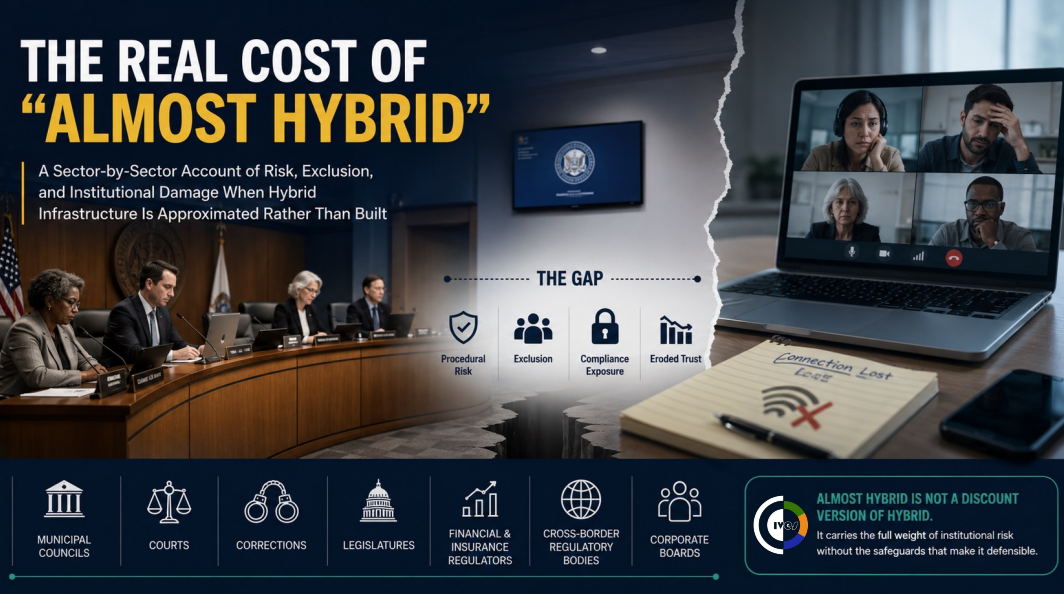
A Sector-by-Sector Account of Risk, Exclusion, and Institutional Damage When Hybrid Infrastructure Is Approximated Rather Than Built
Abstract
This article examines a failure mode that institutional technology discourse rarely names directly: the gap between adopting hybrid meetings and building hybrid infrastructure. Most public bodies, courts, regulators, and boards did not choose to remain fully in person, and very few deliberately chose to build purpose-designed hybrid capability either. Instead, the majority landed somewhere in between — running formal, consequential proceedings on tools adopted for informal convenience. This article argues that “almost hybrid” is not a discount version of hybrid that delivers a proportional share of its benefits. It is a structurally different condition that inherits the full legal, procedural, and reputational exposure of formal institutional process while forfeiting the safeguards that make hybrid process defensible. Working sector by sector — municipal councils, courts, corrections, legislatures, financial and insurance regulators, cross-border regulatory bodies, and corporate boardrooms — it sets out concrete scenarios in which this gap produces real damage: contested votes, excluded participants, compliance exposure, and eroded institutional trust. The costs at stake are significant and cumulative: legitimacy, equity, and resilience eroded quietly, meeting after meeting, until an institution is forced to reckon with them in public, under scrutiny it did not choose the timing of.
1. What “Almost Hybrid” Actually Means
Almost every institution today would describe itself as hybrid-capable. A council allows public comment by video link. A court permits a witness to appear remotely. A board lets a director dial in when travel is impossible. In each case, the institution has technically extended its process beyond the physical room. The question this article asks is what that extension is actually built on.
“Almost hybrid” describes an institution running formal, rule-bound process — a vote, a hearing, a certified record, a regulated disclosure — on infrastructure that was designed for informal convenience: a generic video-conferencing link, an ad hoc dial-in, a screen share with no authentication layer, no continuity procedure, and no built-in accessibility path. The tool works, in the narrow sense that audio and video are transmitted. What it does not do is preserve the properties that made the in-person version of that process legally and institutionally sound: verifiable identity, an auditable record, equal access regardless of language, disability, or bandwidth, and a documented procedure for what happens when the connection fails.
This is the distinction the sectors below are organized around. “Almost hybrid” is not hybrid infrastructure operating at partial capacity. It is a different architecture entirely — one that looks similar from the front of the room and behaves very differently the moment something goes wrong, someone is excluded, or a decision is challenged.
2. A Risk Taxonomy for Institutional Hybrid Failure
Before turning to individual sectors, it is worth naming the categories of harm that recur across all of them. Each sector section below will reference these four categories, because the specific scenario changes but the underlying failure pattern does not.
Procedural validity: Can the vote, hearing, or decision withstand a formal challenge — was participation authenticated, was quorum verifiable, does a certified record exist?
Accessibility and inclusion: Who was structurally unable to participate on equal terms — because of language, disability, bandwidth, geography, or an interface that assumed a level of access not everyone has?
Data sovereignty and security: Where did the recording, transcript, or case data actually reside, under which jurisdiction’s authority, and was that consistent with the institution’s legal obligations?
Institutional trust: What happens to public or stakeholder confidence when a failure in one of the categories above becomes visible — and does the institution have a documented answer, or only an apology?
These four categories are also closely related to concerns that ESG and governance frameworks already formalize, though the fit is not exact. Procedural integrity and auditable decision-making sit squarely within what governance-pillar standards such as GRI and SASB ask organizations to demonstrate: transparent, accountable decision-making backed by a real audit trail. Accessibility and equitable participation echo the broader diversity, inclusion, and community-impact concerns that fall under the social pillar, even though no framework yet names institutional meeting access as a specific disclosure line of its own. “Almost hybrid” infrastructure tends to put several of these dimensions at risk simultaneously, because they are not separate features bolted onto a platform — they are properties of how the platform was architected from the start.
3. Sector by Sector
3.1 Municipal and Metropolitan Councils
Consider a public council meeting where remote public comment is offered through a generic video link with no queuing system, no captioning, and no logged record of who was connected when. A resident joins to testify on a zoning decision that affects their block. Midway through their remarks, their connection drops — unremarkable on a consumer platform, but on a formal public record, the meeting minutes simply show that the speaker “stopped talking,” with no indication that the disconnection was technical rather than voluntary.
The procedural exposure is immediate: a resident whose testimony was cut short by infrastructure, not by their own choice, has a plausible argument that the public comment process was not fairly conducted. The accessibility exposure runs deeper and is harder to see in any single meeting: residents in lower-bandwidth areas, older residents less comfortable troubleshooting a dropped call mid-testimony, and non-native speakers relying on captions that were never built into the platform are all structurally more likely to be the ones who lose their turn to speak. Over many meetings, this does not look like a single incident — it looks like a pattern of whose voice reliably makes it into the public record and whose does not, which is precisely the kind of quiet, cumulative exclusion that ESG social-impact reporting is designed to surface and that open-meeting law was designed to prevent. This category of risk has begun to be codified into law rather than left to institutional discretion: California’s Senate Bill 707, for example, requires eligible local legislative bodies to adopt a written policy for how the body responds to service disruptions during a public meeting, including a minimum recess period before proceedings may resume.
3.2 Courts
A court permits remote testimony or interpretation over a consumer conferencing tool with no certified recording and no verifiable chain of custody for the audio. The hearing proceeds, a decision is reached, and the case appears closed — until the ruling is appealed, at which point counsel asks a simple question: is there a certified, tamper-evident record of exactly what the interpreter said, and precisely when the connection was interrupted, if it was?
When the honest answer is an ordinary recording made on a platform never designed to serve as a legal record, the exposure is not hypothetical. It is grounds for appeal, and in jurisdictions with strong due-process protections, grounds for the original proceeding to be reopened entirely. The inclusion dimension compounds this: parties who require interpretation or captioning are disproportionately the ones affected when those functions are provided as an improvised add-on rather than a native, certified part of the hearing — meaning the population most dependent on accessible process is also the population most exposed when that process is only approximated. This is an access-to-justice failure with a specific, identifiable group bearing the cost.
3.3 Prisons and Correctional Facilities — Family and Legal Visitation
A correctional facility offers video visitation through a platform with no logging of dropped calls and no privacy-compliant record of contact between an incarcerated person and their family or attorney. A call disconnects partway through a legal consultation. There is no log confirming when it occurred, whether it was resumed, or whether privileged conversation was interrupted mid-sentence in a way that compromised the attorney-client relationship.
The procedural risk here intersects directly with constitutional right-of-access protections: an undocumented, unverifiable interruption to legal counsel is a materially different problem than a dropped personal call, and a facility without a certified record cannot demonstrate which one occurred. The human and social dimension is harder to quantify but well documented in corrections research: consistent family contact is associated with better behavioral outcomes and lower recidivism, and unreliable, undocumented visitation infrastructure erodes exactly the contact that supports those outcomes — a real social-impact cost that never appears in a budget line but shows up in recidivism data and in the lived experience of families who cannot reliably reach someone they love.
3.4 Legislatures and Parliaments
A legislative body allows remote members to participate and vote through informal channels — a chat message, a verbal confirmation over an unauthenticated call — rather than a system that structurally verifies identity and quorum. A close vote passes. Afterward, a challenge is raised: was the remote member actually present and authenticated for the full duration of the vote, or is the record relying on the word of whoever was managing the call?
This is not an abstract concern. Where continuity and authentication procedures exist only informally rather than as a designed, tested capability, a legislative body is exposed to exactly the challenge described above: legislation whose validity depends on a vote that cannot be fully verified after the fact.
3.5 Financial, Tax, and Insurance Regulatory Authorities
A regulatory body conducts a confidential hearing — a rate review, an enforcement proceeding, a licensing determination — on a general-purpose platform with no certified encryption standard and no built-in audit trail specific to regulatory recordkeeping requirements. The hearing itself goes smoothly. The exposure surfaces later, when an auditor or an appellant asks for the documented chain of custody for the recording, or when the regulator’s own compliance framework is reviewed and the gap between “we used a secure video tool” and “we used a tool built to our jurisdiction’s recordkeeping and encryption standard” becomes the actual finding.
For institutions that carry statutory recordkeeping obligations — as most financial, tax, and insurance regulators do — this gap is not a technology preference. It is a compliance finding waiting to happen, and one that is entirely invisible until the specific audit or appeal that surfaces it.
3.6 EU and Cross-Border Regulatory Bodies
A regulatory or administrative body operating across jurisdictions holds hearings on cloud infrastructure whose data residency is determined by the vendor’s architecture rather than by the institution’s legal obligations. A hearing involving parties from multiple EU member states is recorded and stored on servers whose jurisdiction does not match the data-residency requirements that apply to the proceeding.
The consequence is not a hypothetical fine. It is a structural conflict between the institution’s own legal obligations — whether under GDPR, sector-specific EU regulation, or a bilateral data-sharing agreement — and the default behavior of a platform it did not choose for its data-governance properties, but for its familiarity. For institutions whose legitimacy depends in part on demonstrating sovereignty over the process they administer, discovering that a routine hearing was, by default, stored outside the jurisdiction that governs it is a governance failure with diplomatic as well as legal weight.
3.7 Corporate Boardrooms and Private-Sector Governance
A company holds a hybrid annual general meeting. Remote shareholders join through a link with no identity verification tied to the shareholder register, and their votes are recorded manually by a staff member typing responses into a spreadsheet as they are called out over an unstable connection. The meeting concludes, resolutions pass, and the minutes describe a vote count that no external party can independently verify against an authenticated log.
This is, in miniature, exactly the failure that shareholder litigation and governance-ratings agencies are increasingly built to catch: a decision-making process that cannot demonstrate, on request, that every participant was who they claimed to be and that every vote was recorded as cast. It is also a direct hit to the “G” in ESG scoring, which increasingly evaluates not just whether a board is diverse or independent, but whether its actual decision-making process is auditable. A boardroom running on “almost hybrid” infrastructure can have excellent governance policies on paper and an indefensible governance record in practice, because the gap between the two lives entirely in infrastructure no one examined until it was tested.
4. The Common Denominator: Why “Almost” Fails Structurally, Not Marginally
Read across these seven sectors, a consistent pattern emerges. In every case, the institution did not lack the intention to be accessible, compliant, or procedurally sound. It lacked infrastructure that made those properties structural rather than aspirational. A generic video tool does not fail to be accessible because no one cared about accessibility; it fails because accessibility — captioning, interpretation, low-bandwidth resilience — was never a design requirement for the tool in the first place. A consumer platform does not fail to produce a certified record because no one wanted one; it fails because certified, tamper-evident recordkeeping was never part of its architecture.
This is the core argument of this article: “almost hybrid” is not hybrid infrastructure delivering a partial share of its intended benefit. It is the full exposure of formal institutional process, running on infrastructure that was never asked to carry that weight, producing full-scale procedural, inclusion, sovereignty, and trust risk while delivering only the appearance of modernization. The gap between “almost” and “actually” hybrid is not a matter of degree. It is a matter of what the underlying system was built to do.
5. A Practical Self-Audit: Questions Every Institution Should Ask
The scenarios above point toward a consistent, practical set of questions that any public body, court, regulator, or board can put to its current meeting infrastructure — regardless of sector, size, or budget.
- Authentication: Can the platform structurally verify who is participating and voting, or does that verification depend on a staff member recognizing a voice or a name in a chat window?
- Continuity: Is there a documented, tested procedure for what happens to an in-progress hearing, vote, or meeting when connectivity fails — or does continuity depend on whoever happens to be in the room that day?
- Auditability: Does a certified, tamper-evident record of the proceeding exist as a built-in institutional capability, or as an ordinary recording that was never designed to serve as a legal or regulatory record?
- Accessibility: Are captioning, interpretation, and low-bandwidth accommodation native to the participation experience, or dependent on a separately procured service that may not be available every time it is needed?
- Data sovereignty: Is it clear, without needing to ask the vendor, which jurisdiction’s legal authority governs the recordings and data this proceeding generates — and does that match the institution’s own obligations?
- Equal participation: If a remote participant is disconnected mid-proceeding, does the record distinguish a technical failure from a voluntary departure — and would that distinction survive being challenged in public?
None of these questions are exotic, and none require specialized technical expertise to ask. What they require is treating them as design requirements to evaluate before an incident, rather than as explanations to construct after one. An institution that cannot answer most of these questions today is very likely running “almost hybrid” infrastructure, whatever its meeting software happens to be called.
6. Conclusion: Infrastructure Is the Compliance Decision
None of the failures described in this article required bad intent. They required only the ordinary, understandable choice to adopt a familiar, general-purpose tool for a purpose it was never designed to serve — a choice made, in good faith, at institutions across every sector examined here. That is precisely what makes “almost hybrid” a durable risk rather than a passing one: it does not announce itself as a shortcut. It looks, from the front of the room, exactly like hybrid infrastructure working as intended, right up until the moment a vote is challenged, a participant is excluded, a record is subpoenaed, or a regulator asks a question the institution cannot answer.
Cives was built on the conviction, encoded in its own name — the Latin plural of citizen — that every person who depends on a public or regulated institution is entitled to the same quality of access and the same procedural protection, regardless of language, disability, or geography, and that this protection should not depend on which day the institution’s infrastructure happens to fail. The sectors examined in this article are different in almost every respect — caseload, statute, constituency, risk profile — but they share a single underlying fact: the cost of “almost hybrid” is paid not by the institution’s budget, but by the people who trusted its process to hold. Closing that gap is not a technology upgrade. It is a compliance, equity, and governance decision that most institutions have not yet realized they are already making, by default, every time they open a meeting link.