The Rise of Hybrid Meetings: Adoption, Impact and Sectorial Transformation
Introduction
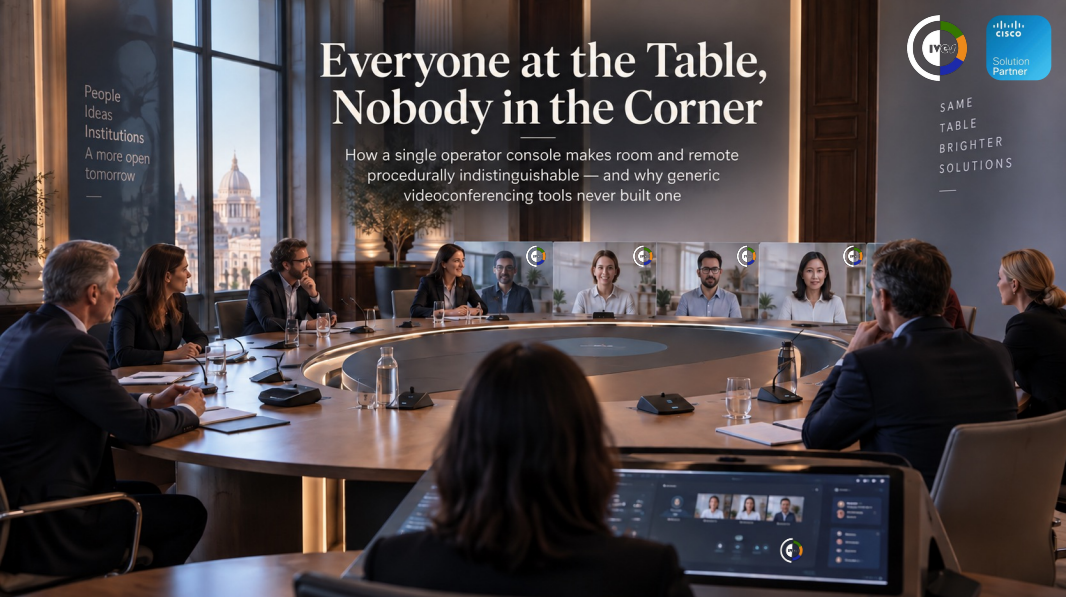
How a single operator console makes room and remote procedurally indistinguishable
— and why generic videoconferencing tools never built one
Abstract
Every comparison between institutional collaboration platforms and generic videoconferencing tools tends to focus on what participants see: voting buttons, captioning, translated audio. This paper examines a layer most comparisons miss entirely — the operator console: the interface used not by attendees, but by the person actually running a formal meeting. Drawing on the architecture of the operator console built into the Cives platform — the same console, applied today to both legislative assemblies and corporate and institutional boardrooms — this paper argues that the absence of an equivalent layer in mainstream videoconferencing platforms is not an oversight correctable by a plugin. It is a structural consequence of what those platforms were built to assume: that meetings are informal, that no one needs to prove who held the floor and when, and that a single unified control surface for seats, delegations, and quorum rules is not worth building because no generic meeting requires one. The console's single most consequential effect is one this paper places at its centre: it makes it structurally impossible to tell, from the record or from the floor, who was sitting at the table and who joined from another continent — a genuine erasure of the distinction between room and remote that generic “hybrid” support, built on two separate participant lists bolted together, cannot replicate. Formal institutional meetings require exactly that parity, and the gap between the two has already produced documented legal exposure — not hypothetically, but in the specific, citable disputes over quorum validity and board record adequacy examined later in this paper.
1. The Role Nobody Automated
Every formal meeting — a legislative session, a board of directors, a regulatory hearing — depends on someone whose job is not to participate but to run the room: confirming who is present and entitled to vote, managing the order in which people speak, tracking which agenda item is active, and producing a record precise enough to survive scrutiny months or years later. In legislatures this person is typically a clerk; in corporate governance, a company secretary. The role is old, the tooling supporting it is not.
The administrative burden this creates is not abstract. Corporate secretaries are expected to distribute minutes within 24 to 48 hours of a meeting's conclusion, maintain records sufficient to satisfy governance frameworks such as Nasdaq listing standards and, in the United States, Sarbanes-Oxley documentation requirements — and to do so while simultaneously running the meeting itself. Vendors building AI-assisted minute-taking tools for this specific administrative gap estimate the manual burden at several hours per week per secretary, a figure consistent with the informal complaint heard across governance literature: the person responsible for producing a defensible record of a meeting is, in the overwhelming majority of institutions today, doing so with a notepad, a stopwatch, and whatever host controls a generic video platform happens to expose.
Generic videoconferencing platforms give that person a mute button and a spotlight function. Neither is a substitute for a console built around seats, delegations, quorum rules, and a defensible speaking-order record — which is precisely the layer this paper examines.
2. Anatomy of the Console
A single operator console architecture underpins the Cives platform, applied consistently across every institutional context it serves, without a rebuild of the underlying feature set from one deployment to the next. That a single console adapts across such structurally different institutions is itself evidence, examined further in Section 7, that this is a genuine functional category rather than a bespoke feature built for one customer. The console's ten capabilities cluster into four functional groups.
Identity and Authorization
The console maintains a live seating map showing office, microphone, hand-raise, and login status for every seat, whether occupied in person or remotely. Guest invitations are configured with role, group, and an on-site NFC identifier in a single dialog — turning admission into a controlled, auditable action rather than a link shared by chat. Individual seats can be logged in, logged out, or resynchronised directly from the floor plan, and remote delegates receive the same granular control — mic, camera, speaker, interpretation channel — as attendees physically in the room.
Procedural Integrity
A live quorum panel lets the operator toggle which rules apply for the session and shows a continuously updated pass-or-fail read-out, timestamped, for each one. Agenda management steps the operator through scheduled discussion items, with the active item driving speaking allotments in real time rather than being tracked separately on paper.
Floor Control
A unified Request to Speak queue merges hands raised in the room with hands raised remotely into a single, priority-ordered list. Moderation actions — unmute, raise or lower a hand, eject — are applied directly from that queue, and a speaking timer appears on-screen the moment the floor is given, with extension and chime controls available on the fly.
The Defensible Record
Perhaps the single capability with the most direct legal relevance: the Request to Speak queue can be exported to a timestamped PDF on demand, capturing name, seat, request type, and time for every intervention. Where a regulator, a shareholder, or a challenger to a council resolution later disputes whether a particular member was given a fair opportunity to speak, this is the artifact that answers the question — generated automatically, not reconstructed from memory after the fact.
3. Erasing the Distinction Between Room and Remote
Among everything the console does, this is the capability the rest of this paper's argument ultimately rests on. Most platforms that call themselves “hybrid” achieve it by running two meetings side by side and stitching them together: a physical room with its own participant list, its own audio controls, its own recording, and a remote call with a second, entirely separate set of the same. Anyone who has sat in a boardroom watching a screen labelled “remote attendees” as a small tile in the corner — audible, technically present, but visibly and procedurally second-class — has experienced this first-hand. The IT, AV, and security teams behind that arrangement are often managing two systems, not one, and reconciling them into a single record after the fact.
The console eliminates that seam entirely. There is one participant list, one set of audio and video controls, one request-to-speak queue, one timer system, one vote and one set of results — regardless of whether a given seat is occupied by someone physically at the table or joining from a different continent and time zone. A delegate dialling in from another hemisphere holds exactly the same standing on the console's seating map, the same position in the speaking queue, and the same voting weight as the colleague seated two chairs down from the chair. Nothing in the interface, the record, or the procedure marks one as more present than the other.
This is not a cosmetic convenience. It is the condition that makes a meeting genuinely hybrid rather than merely hybrid-shaped: an assembly where geography stops being a variable in how seriously a contribution is taken, how quickly a hand is recognised, or how completely a vote is counted. A quorum rule that counts remote and in-person seats identically, a speaking queue that does not silently deprioritise a hand raised over video, and a vote tally that draws no distinction between the two — these depend entirely on the single, unified object model examined in Section 2. Bolt two separate systems together, as generic platforms do, and the seam between them reappears exactly where it matters most: in who gets recognised to speak, whose vote gets counted on time, and whose presence the official record actually reflects.
4. The Evidence: Truly Hybrid in Practice
The claim that room and remote participation can carry identical procedural standing rests on a specific, testable definition of what makes a meeting genuinely hybrid rather than hybrid in name only: one in which every participant, regardless of location, holds equal procedural standing, equal access to information, and equal participation rights. Two concerns already central to this paper converge on that same standard from different directions. Procedural fairness requires that who is recognised to speak next cannot depend on which side of a video connection a member happens to be on — a session that quietly privileges whoever is physically present is not neutral, however clean its outcome looks on paper. Governance integrity raises the same concern under a different name: locational bias, the risk that visibility and influence end up disproportionately granted to whoever is in the room, independent of the merits of what they contribute. A session that satisfies one of these standards but not the other is not genuinely hybrid. It only looks that way from inside the room.
The more concrete evidence sits closer to the two institutional categories this paper has centred throughout: legislative and council bodies, and corporate or institutional boardrooms. Deployments already in daily use span both. On the legislative and council side, sitting municipal and regional councils in North America and Europe run their formal sessions on this infrastructure, alongside government ministries and regulatory authorities across the Gulf. On the boardroom side, deployments include governance-grade sessions for the boardroom of major multilateral financial institutions — exactly the kind of setting in which a director joining from another country cannot be allowed to carry less procedural weight than one seated at the table without the institution's own governance standards being called into question.
The same requirement shows up from the opposite direction in how legislative continuity actually has to work in practice: quorum and roll-call logic has to be built into the platform itself, evaluated automatically, rather than tracked separately on a spreadsheet or a whiteboard by whichever clerk happens to be reachable that week when a session is called on short notice. Council and boardroom deployments already running on this infrastructure are what that requirement looks like once it has moved from a design principle to routine, daily operation — not asserted in the abstract, but exercised in ordinary sessions, month after month.
5. Why Generic Platforms Cannot Simply Add This
The absence of an equivalent console in mainstream collaboration platforms is not a prioritization gap that a future product update closes. It is a consequence of a data model that has no concept of the objects a formal meeting actually operates on. A generic platform's host controls operate on participants — undifferentiated entries in a list, each with the same mute, spotlight, and remove actions available. A formal institutional meeting operates on seats, delegations, quorum rules, and agenda items — objects with relationships to each other (a seat belongs to a delegation; a delegation's vote may count once regardless of how many members are logged in; a quorum rule may apply to the whole assembly or only to a sub-committee) that a generic “participant” object was never designed to express.
This is the same architectural argument this publication has made about institutional platforms generally, applied here at the level of a single interface. Adding a request-to-speak queue to a generic platform is a feature request. Adding a request-to-speak queue that treats a seat at the table and a seat joining from across the world as procedurally identical is a data-model change — which is precisely why it tends not to happen, and why the console gap persists even as individual features (captioning, breakout rooms, polling) continue to accumulate on generic platforms.
6. The Legal Stakes of the Missing Console
The console's outputs are not merely convenient — they map directly onto categories of institutional risk already documented elsewhere. Recent amendments to a major U.S. state's corporate law narrowed shareholders' formal right to inspect company records. But when a company's board minutes are too thin to answer questions on their own, courts have retained the power to allow a much broader search instead — one that can reach emails and informal messages, not just the official record. A console that produces a timestamped, exportable speaking-order record on demand is a direct, structural answer to exactly that exposure: the kind of clean, contemporaneous documentation that keeps a dispute confined to the official record rather than opening the door to a party's private correspondence.
Quorum carries a parallel stake. A case currently pending before a U.S. federal appellate court is testing whether remote or proxy participation can lawfully satisfy a formal quorum requirement at all — a live illustration that quorum status is not a background detail but a question institutions may eventually have to defend under oath. A console that counts remote and in-person seats on identical terms, and shows quorum as a continuously updated, timestamped, rule-by-rule status rather than a number someone announces from memory, is the difference between an institution that can answer that question immediately and one that has to reconstruct an answer after the fact, under pressure, from incomplete notes.
7. One Console, Every Formal Body
The clearest evidence that this operator layer represents a genuine architectural category — not a one-off feature built to satisfy a single client — is that a single console, largely unchanged, already serves institutions well beyond the two headline categories of parliament and boardroom. What varies across these contexts is never the console's underlying objects — seat, delegation, quorum rule, agenda item — nor the room-remote parity described in Section 3, only what those objects represent locally:
- Legislative assemblies and municipal councils — a seat is an elected representative, a delegation is a party or regional bloc, and quorum is the statutory minimum set out in the assembly's own rules of procedure. Get the count wrong here and a vote taken that day can be challenged, or an entire session invalidated, months after the fact.
- Multilateral and diplomatic committees — a seat is a member-state delegation, itself a small group with a head and alternates, and quorum is a treaty-defined participation threshold rather than a simple headcount. A miscounted delegation can call into question whether a resolution binding dozens of sovereign states was ever validly adopted in the first place.
- Corporate and institutional boardrooms — a seat is a director, a delegation is a proxy holder voting on another member's behalf, and quorum is whatever a company's bylaws define as the minimum for a binding resolution. Without a reliable record of who held the floor and when, a contested board decision can expose the company to exactly the kind of broad, uncontrolled discovery examined in Section 6.
- Regulatory and financial-authority boards — a seat is a commissioner or governor, a delegation is an alternate member standing in for a principal, and quorum is frequently a supermajority given the market-moving weight of the decisions involved. A quorum dispute at this level is never a mere formality — it can call into question a ruling that moved markets or committed public funds.
- Academic senates and institutional governance bodies — a seat is a faculty or student representative, a delegation may be a departmental bloc, and quorum governs decisions ranging from curriculum changes to disciplinary rulings that a university's own charter requires to be properly constituted.
A legislative clerk managing delegation voting weights and a corporate secretary managing shareholder proxies are, from the console's point of view, solving the same underlying problem: verifying authority, tracking who holds the floor, and producing a record that will still make sense to someone reading it a year later. The same is already true, in practice, of a financial-authority board secretary tracking a supermajority requirement, or a multilateral committee secretariat confirming that enough member states are represented to proceed — all served today by the same single console, not a bespoke build for each. Generic videoconferencing platforms have no equivalent starting point: no concept of a seat, a delegation, or a quorum rule to begin with. Specialist institutional vendors typically go the other way, building a dedicated tool per vertical — a parliamentary voting system here, a board-management platform there — each rebuilding the same underlying logic from scratch. What sets Cives apart is running one console architecture across this entire span of institutions — legislatures, multilateral bodies, corporate boards, and financial regulators alike — without forking the product for each. Given how directly each of these decisions touches money or the legitimacy of a binding public act, that is not a minor engineering convenience — it is the difference between an institution that can defend its process and one that is improvising it in real time.
8. Conclusion
The gap between institutional and generic collaboration platforms is usually described in terms visible to meeting participants: accessibility, translation, voting. This paper has examined a layer that participants rarely see at all — the console used by the person actually responsible for running the meeting and producing its record — and the single effect that layer makes possible: a meeting in which the distinction between the room and the rest of the world simply disappears. That layer does not exist in generic platforms not because it has been overlooked, but because the object model those platforms are built on has no room for it; bolting two separate systems together produces a hybrid meeting in name, with the seam between room and remote still visible in exactly the moments — recognition, voting, the record — where it matters most. A single console architecture already serving parliaments, multilateral committees, corporate boardrooms, and financial-authority boards alike is not an incidental feature. It is the clearest evidence available that Cives occupies a category of its own: an institutional collaboration platform built around one reusable console for the seats, delegations, and quorum rules every one of these institutions actually runs on, in which a member joining from another continent carries exactly the same standing as one seated at the table. The documented legal exposure around inadequate quorum records and board minutes only sharpens the point — this is a category every institution in this paper's scope will need an answer for, and Cives has already built it once, for all of them.
Cives exists because participation is only as real as the standing it carries. We build infrastructure in which no seat counts for less because of where it joins from — not the room, not the boardroom, not the chamber on the other side of the world — because the Latin word encoded in our name admits no exceptions. Every civis. Every seat. Every time. That is not a convenience. It is the condition a meeting has to meet before it can call itself hybrid at all.
We believe that legislatures, boardrooms, and institutional bodies deserve infrastructure that reflects their highest purpose: equal standing, equal voice, an equal claim on the record. We build to that standard — and we hold ourselves to it — because the institutions we serve, and the people who depend on their decisions, deserve nothing less.
Introduction

Abstract
Why the public sector needs a different answer than the private one