6 min read

How Cives Is Redefining Government Collaboration on Cisco Webex

How Cives Is Redefining Government Collaboration on Cisco Webex

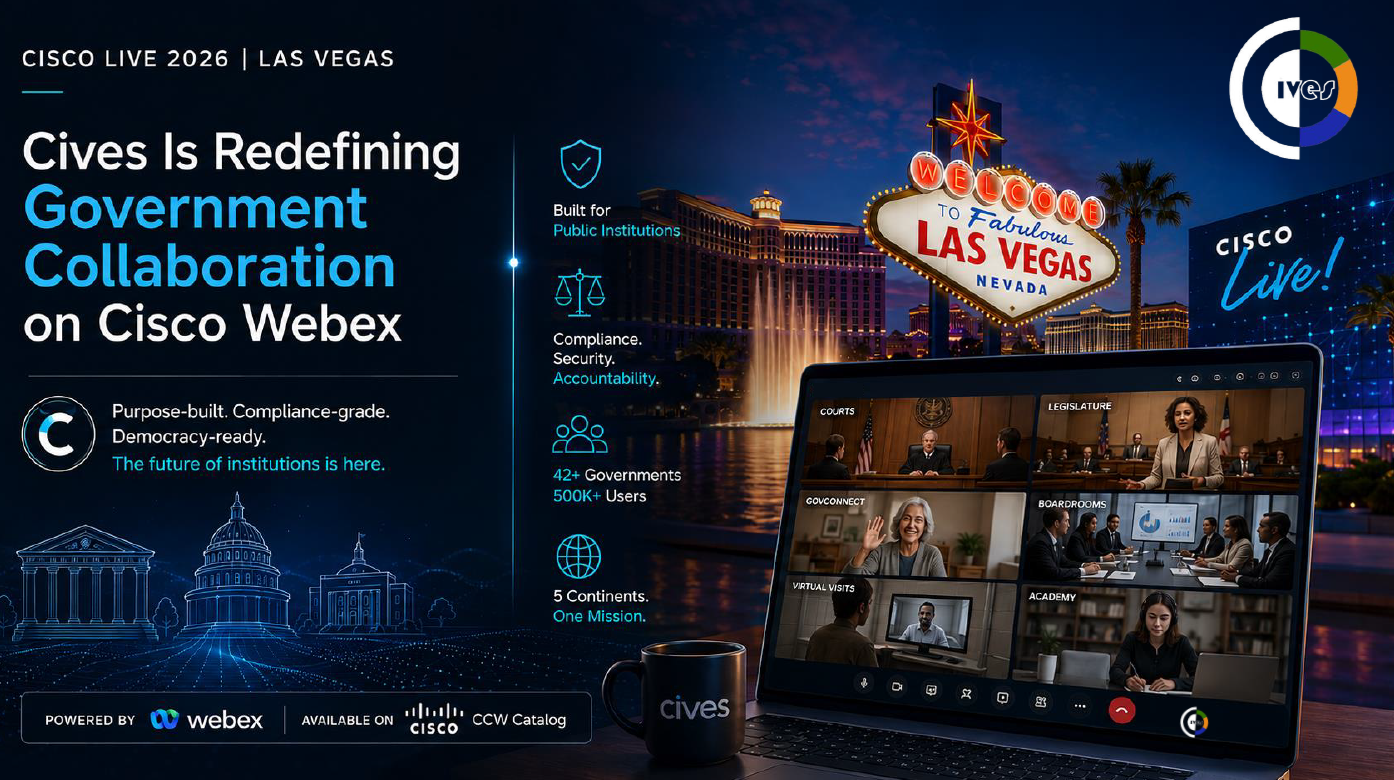
This week in Las Vegas, Cisco Live 2026 brings together thousands of technology leaders to debate the future of intelligent infrastructure, AI-powered collaboration, and the next generation of enterprise networking. The keynotes, the demos, the partner announcements — all of it pointing in one direction: toward a world where technology doesn't just connect people, but enables institutions to operate in fundamentally smarter ways.

It is exactly the right moment to talk about Cives, because what Cives has been building — quietly, deliberately, across 42 governments and five continents — is precisely the vision that Cisco Live 2026 is celebrating. An AI-powered platform for institutional hybrid collaboration, built natively on Cisco Webex, purpose-designed for the courts, parliaments, regulatory bodies, and public administrations that form the operational backbone of democratic society.

While the industry gathers to discuss where collaboration technology is going, Cives is already there.

When Generic isn’t Enough

The collaboration software market is vast and well-served. There is no shortage of capable, polished, widely-adopted platforms. And for most use cases — a team standup, a client call, a company all-hands — they are genuinely good enough.

But governments are not companies. Courts are not startups. Parliaments are not sales teams.

Every public institution operating in a democratic society carries a set of obligations that have no equivalent in the corporate world: open meeting laws, chain-of-custody requirements for legal proceedings, accessibility mandates, language equity obligations, compliance archiving, quorum management, role-based access hierarchies that mirror institutional authority. These are not edge cases or technical requirements to be addressed in a future release. They are the institutional fabric. And generic collaboration tools — however capable — were simply not designed for them.

This is the gap Cives was built to close. Not by adapting a consumer-grade platform, but by designing one from the ground up around the specific requirements of regulated, high-stakes, democratic institutions. The distinction matters enormously in practice. A platform that makes certain compliance behaviors possible is fundamentally different from one that makes them enforced, documented, and legally defensible. Cives is the latter.

Built in a Crisis, Proven Over Time

The story starts in the early months of the pandemic, when governments worldwide faced an existential challenge: how do you keep the machinery of democracy running when you cannot put people in the same room?

Cives’ platform was born on Cisco Webex during that period, and deployed by multiple governments globally within months. The speed of that initial deployment was remarkable — but what proved more significant was what happened afterward. The emergency passed. The "temporary" solutions were supposed to revert. And yet the governments that had deployed Cives did not go back. They stayed, expanded, and brought others in.

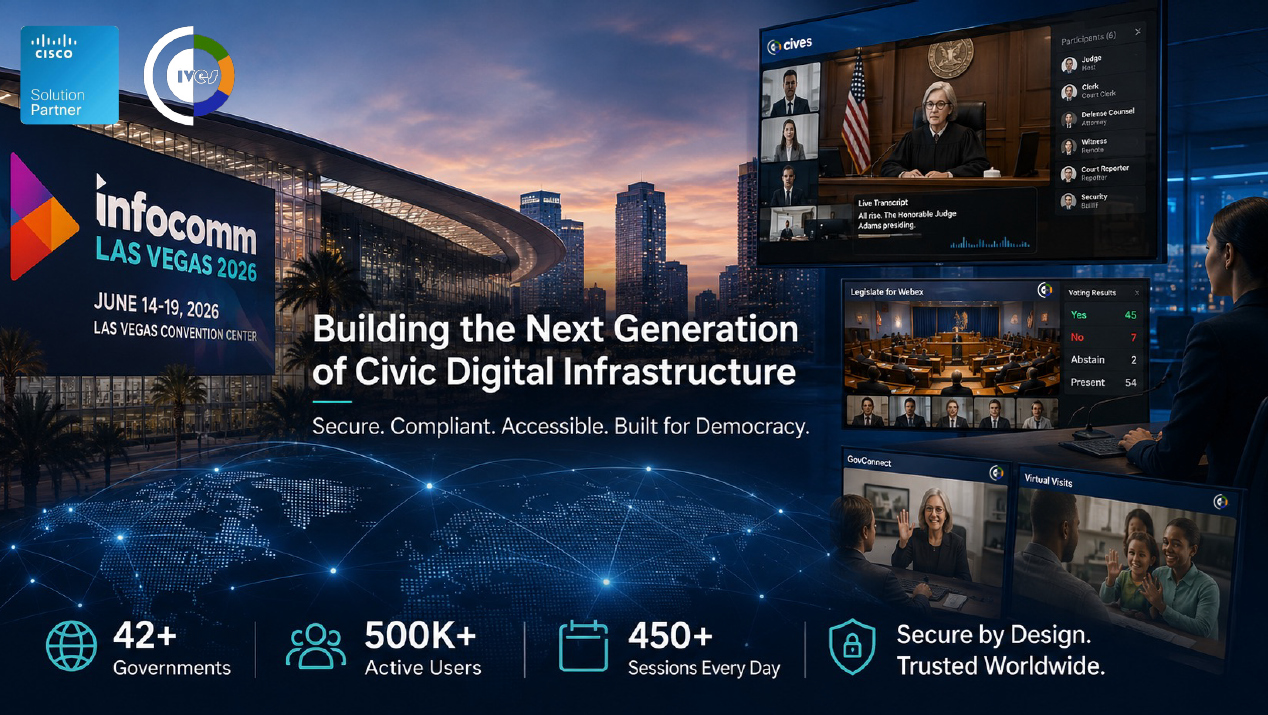
That persistence is the real validation. Today, Cives serves over 42 government customers, processes more than 450 sessions per day, and has a user base exceeding 500,000 active users across more than 25,000 cloud sessions spanning five continents. Its customer base includes financial authorities, municipal and metropolitan councils, EU regulatory bodies, administrative judiciary authorities, tax and revenue agencies, civil and administrative courts, and prison and rehabilitation services.

These are not pilot deployments. They are institutional dependencies.

What Cives Actually Does

The platform encompasses five solutions, each targeting a critical domain of institutional life — all integrated with Cisco Webex, all available through the Cisco CCW Catalog.

Courts for Webex enables genuinely hybrid judicial proceedings. A hearing where the judge is in the courtroom, defence counsel is remote, a witness participates from another city, and the entire session is automatically transcribed with a legally admissible chain-of-custody record — this is not a theoretical scenario. It is a daily operational reality for courts using Cives. Role-based access mirrors courtroom hierarchy. Procedural safeguards preserve due process. The platform conforms to WCAG 2.2 Level AA accessibility standards — already meeting the U.S. Department of Justice's ADA compliance deadlines before they arrive.

Legislate for Webex brings the same institutional rigor to parliaments and legislative bodies. Voting management, debate facilitation, quorum tracking, and simultaneous real-time interpretation in multiple languages are embedded within the workflow — not bolted on. Lawmakers can participate from anywhere without compromising the procedural integrity their institutions require.

GovConnect connects citizens directly to government services through secure video. This is digital proximity made practical: a rural resident accessing a benefits office, an elderly citizen engaging a public agency, a small business completing a regulatory process — without a journey, without a queue, without a barrier. The reduction in travel and infrastructure costs is quantifiable. The democratic impact is harder to measure but no less real.

Boardrooms for Webex extends the same compliance-grade architecture into corporate governance — hybrid AGMs, board meetings, and executive decision-making that benefit from the same security, documentation, and access control infrastructure built for the public sector.

Virtual Visits is perhaps the most human of the five solutions. For correctional facilities managing a well-documented global crisis — overcrowding, inadequate mental healthcare, catastrophically high suicide rates, families separated by distance and cost — virtual visitation is not a convenience feature. Regular family contact demonstrably reduces reoffending rates and improves rehabilitation outcomes. Virtual Visits makes that contact accessible, secure, and dignified, within the security constraints that physical visitation cannot always accommodate.

The Market Behind the Mission

The commercial case for what Cives is building is substantial. Across govtech, smart courts, telehealth, enterprise collaboration, and professional AV, the sectors Cives serves collectively represent one of the largest and fastest-growing addressable markets in the technology industry — fuelled by a global wave of public sector digitalisation that shows no sign of slowing. These sectors share a single underlying need: institutional-grade hybrid collaboration, built for trust, compliance, and scale.

The tailwinds are structural and global. NextGenerationEU and national recovery plans are channeling unprecedented capital into digital public infrastructure across Europe. Federal and state modernisation programmes are doing the same across the Americas. Vision 2030 agendas across the Gulf and Smart Nation strategies throughout APAC are accelerating the same transformation. Every one of those investment programmes eventually reaches the same question: what platform do institutions actually operate on?

Cives is already the answer for 42 governments. The opportunity ahead is orders of magnitude larger.

Sovereignty as a Strategic Differentiator

One dimension of the Cives proposition that carries particular weight in the current geopolitical environment is data sovereignty. The platform can be deployed on-premise, in the cloud, in a hybrid configuration, or as a partner-hosted managed service. Government clients who require local data residency, national jurisdiction compliance, and end-to-end encryption get it as a native capability, not an afterthought.

In Europe especially, where the debate around digital sovereignty is reshaping procurement at every level of government, this matters enormously. A platform that can be deployed through a national telco's infrastructure — with institutional data never leaving national jurisdiction — is not merely commercially attractive. In many procurement contexts, it is politically necessary.

For Cisco partners and telcos operating in this space, the Cives proposition is direct: your network infrastructure, your trusted client relationships, your compliance expertise — combined with a platform purpose-built for the institutional market — equals a sovereign digital platform capability that no global OTT provider can replicate. Connectivity is becoming a commodity. Platforms are where the margin lives.

A Name With a Commitment Inside It

The name comes from Latin. Cives is the plural of civis — citizen. In the political philosophy of the Roman Republic, the civis was not a subject of the state but an active participant in its governance, endowed with rights, obligations, and voice. The founders chose this name deliberately, and it encodes a commitment that runs through the entire architecture of the platform: every citizen, regardless of ability, location, language, or circumstance, should be able to access the institutions of democratic life on equal terms.

This is not an aspiration statement. It is a design brief. The Courts solution is built to WCAG 2.2 Level AA because a deaf litigant has the same right to a fair hearing as anyone else. GovConnect exists because a rural citizen's claim on public services is no smaller than an urban one. Legislate supports simultaneous interpretation because a non-English-speaking resident of a municipality governed by SB 707 has the same right to understand and address their local government as a native speaker.

The essence of democracy, as the company frames it, is not merely the ability to vote — it is the ability to witness governance in action and to participate in it. That belief is embedded in every product decision Cives makes.

Government Can't Wait

The conversations happening in Las Vegas this week are largely about enterprise transformation: how AI makes networks smarter, how hybrid work reshapes the office, how collaboration technology accelerates business outcomes. These are important conversations.

But there is another transformation underway — slower, less visible, but arguably more consequential. The institutions that underpin democratic society are being digitized, whether they are ready or not. Courts, parliaments, regulatory bodies, public agencies: all of them are being asked to operate across hybrid environments, to serve populations that expect digital access, to meet accessibility and compliance standards that keep expanding, and to do all of this with the same budgetary constraints and risk aversion that have always characterized the public sector.

Most of them are attempting this transformation with tools designed for a different purpose. The mismatch is not always visible until a legal challenge arrives, a compliance audit exposes a gap, or a citizen is effectively excluded from a proceeding because the platform was not designed with them in mind.

Cives is the company building the platform these institutions actually need. It is doing so at scale, in live deployment, across some of the most demanding regulatory environments on the planet.

While the technology world watches Cisco Live this week, that work continues — 450 sessions a day, 42 governments, five continents.

That is the story worth telling.