5 min read

InfoComm 2026 and the Rise of Civic Digital Infrastructure

InfoComm 2026 and the Rise of Civic Digital Infrastructure

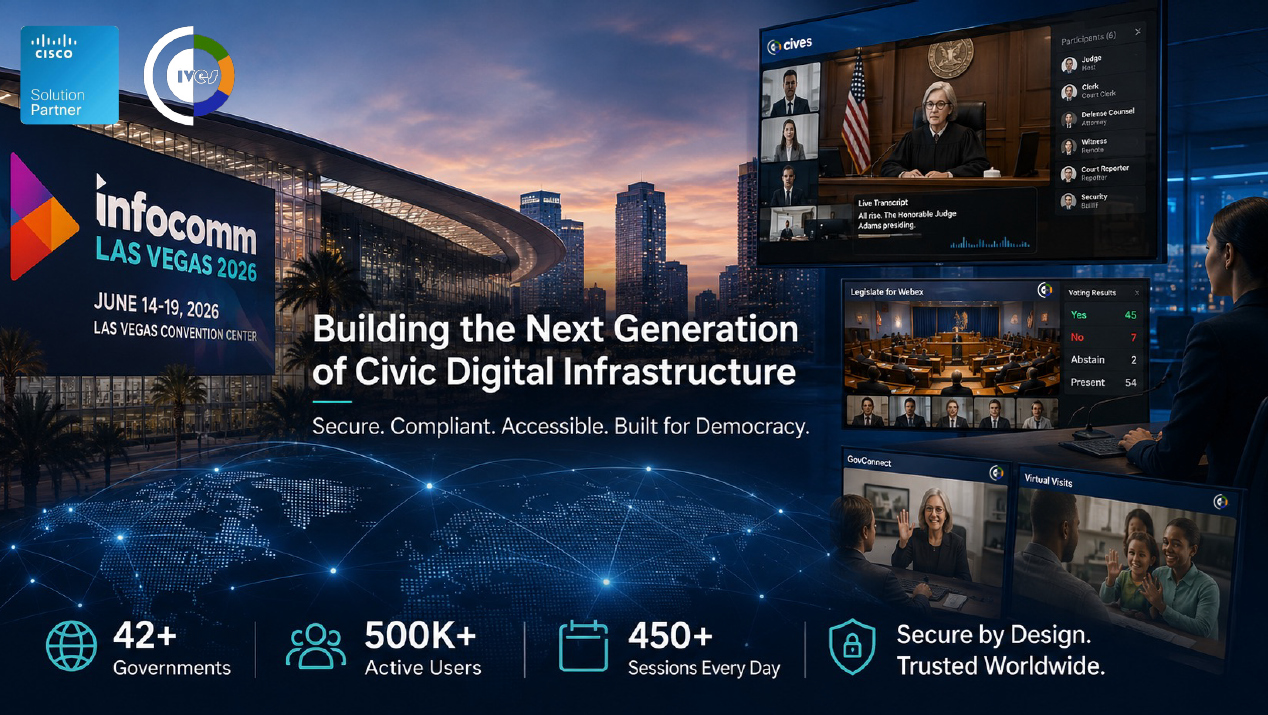
InfoComm 2026 opens this week at the Las Vegas Convention Center, gathering the global Pro AV and collaboration industry to debate the future of immersive environments, AI-powered experiences, and intelligent meeting infrastructure. The conversations will be important. But somewhere beyond the show floor, a quieter transformation is already underway — one that Cives has been building for years, at the very heart of democratic society.

The Show That Shapes the Industry

Every June, InfoComm resets the industry's compass. This year's edition in Las Vegas arrives at a pivotal moment: AI is reshaping how meetings are designed, hybrid environments are moving from workplace amenity to critical infrastructure, and the lines between physical spaces and digital collaboration are dissolving.

The themes on the floor will be familiar to anyone following the collaboration technology sector — intelligent AV systems, cloud-native platforms, seamless device interoperability, and the race to make every meeting room feel like everyone is in the same place. Major vendors will unveil hardware, integrators will explore new deployment models, and the industry will collectively ask: where does collaboration go from here?

It is exactly the right question. And for Cives, the answer is already being written — 450 times a day, across 42 governments, on four continents.

When Compliance Is Not Optional

The Pro AV and collaboration industry has done a remarkable job serving the enterprise market. Corporate headquarters, university campuses, healthcare networks, and financial institutions are well-served by a mature ecosystem of platforms, devices, and integration expertise.

But there is a category of organization that sits at the very core of democratic society — courts, parliaments, regulatory bodies, public administrations, corrections systems — where the standard collaboration toolkit was never designed to operate. Not because the technology is incapable, but because the requirements are categorically different.

These organizations carry obligations that have no equivalent in a corporate all-hands or a team standup: open meeting laws, chain-of-custody requirements for legal proceedings, accessibility mandates under the Americans with Disabilities Act, language equity obligations, compliance archiving, quorum management, and role-based access hierarchies that mirror constitutional authority. A platform that makes certain compliance behaviors possible is fundamentally different from one that makes them enforced, documented, and legally defensible.

That gap is precisely where Cives was built to operate.

Built in a Crisis. Proven Over Time.

Cives’ platform was born during the early months of the pandemic, when governments around the world faced an existential challenge: how do you keep the machinery of democracy running when you cannot put people in the same room?

The platform was developed natively on Cisco Webex and deployed by multiple governments globally within months. What proved more significant than the speed of that initial deployment was what happened afterward. The emergency passed. The "temporary" solutions were supposed to revert. The governments that had deployed Cives did not go back.

They stayed. They expanded. They brought others in.

That persistence is the real validation. Today the scale speaks for itself:

  • Half a million active users who depend on Cives not as a convenience, but as infrastructure
  • Over 450 sessions every day — hearings, legislative votes, citizen appointments, board decisions
  • A deployment footprint that spans continents and keeps growing

These are not pilots. They are civic dependencies.

Five Solutions. One Governance Architecture.

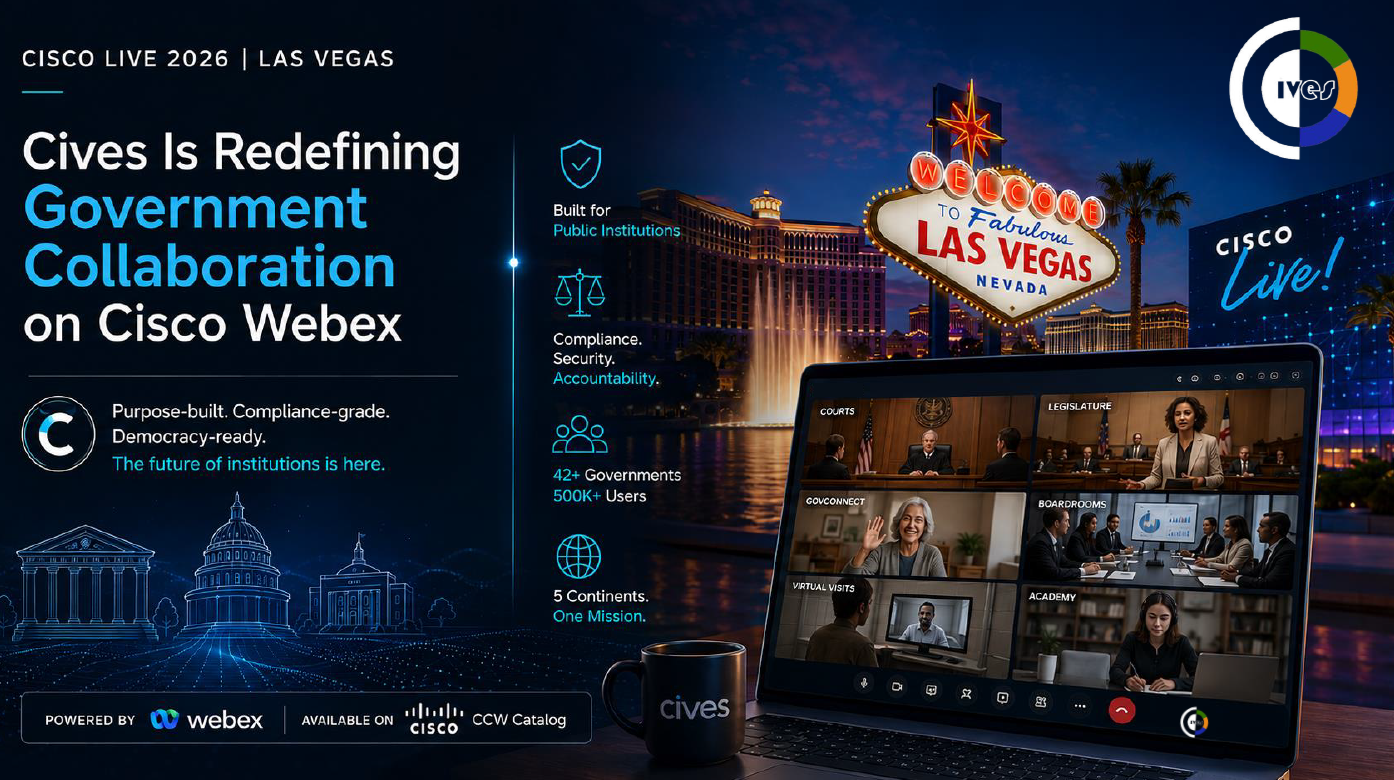
The Cives platform encompasses five solutions, each targeting a critical domain of public and civic life — all built on Cisco Webex, all available through the Cisco CCW Catalog.

Courts for Webex enables genuinely hybrid judicial proceedings. A hearing where the judge is in the courtroom, defence counsel is remote, a witness participates from another city, and the entire session is automatically transcribed with a legally admissible chain-of-custody record — this is a daily operational reality for courts using Cives. Role-based access mirrors courtroom hierarchy. Procedural safeguards preserve due process. The platform conforms to WCAG 2.2 Level AA accessibility standards, meeting the U.S. Department of Justice's ADA compliance deadlines ahead of schedule.

Legislate for Webex brings the same rigor to parliaments and legislative bodies. Voting management, debate facilitation, quorum tracking, and simultaneous real-time interpretation in multiple languages are embedded within the workflow — not bolted on. Lawmakers can participate from anywhere without compromising procedural integrity.

GovConnect connects citizens directly to government services through secure video. A rural resident accessing a benefits office, an elderly citizen engaging a public agency, a small business completing a regulatory process — without a journey, without a queue, without a barrier. Digital proximity made practical.

Boardrooms for Webex extends the same compliance-grade architecture into corporate governance — hybrid AGMs, board meetings, and executive decision-making with the security, documentation, and access controls built for the public sector.

Virtual Visits addresses one of the most human challenges in corrections: regular family contact demonstrably reduces reoffending rates and improves rehabilitation outcomes. Virtual Visits makes that contact accessible, secure, and dignified within the security constraints that physical visitation cannot always accommodate.

What InfoComm 2026 Signals for Civic Collaboration

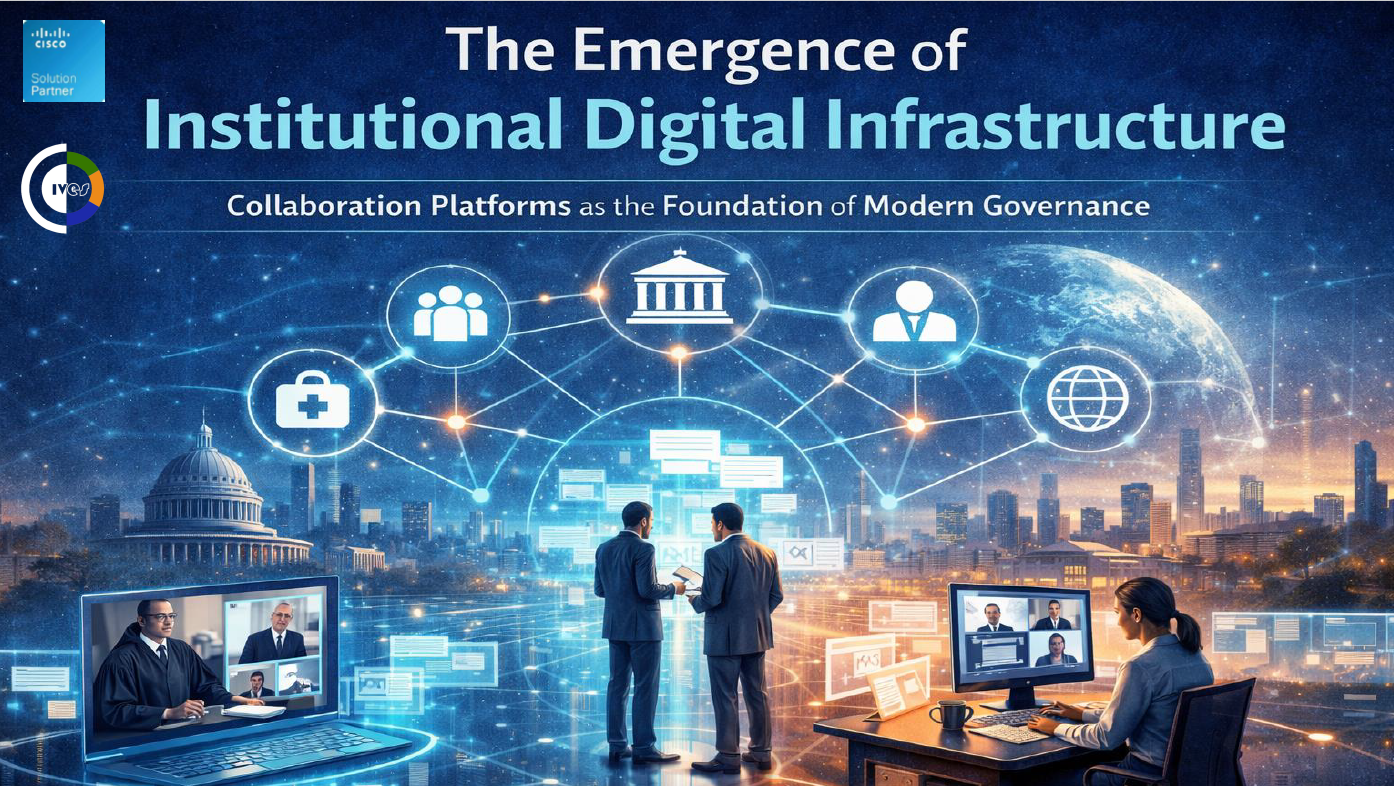
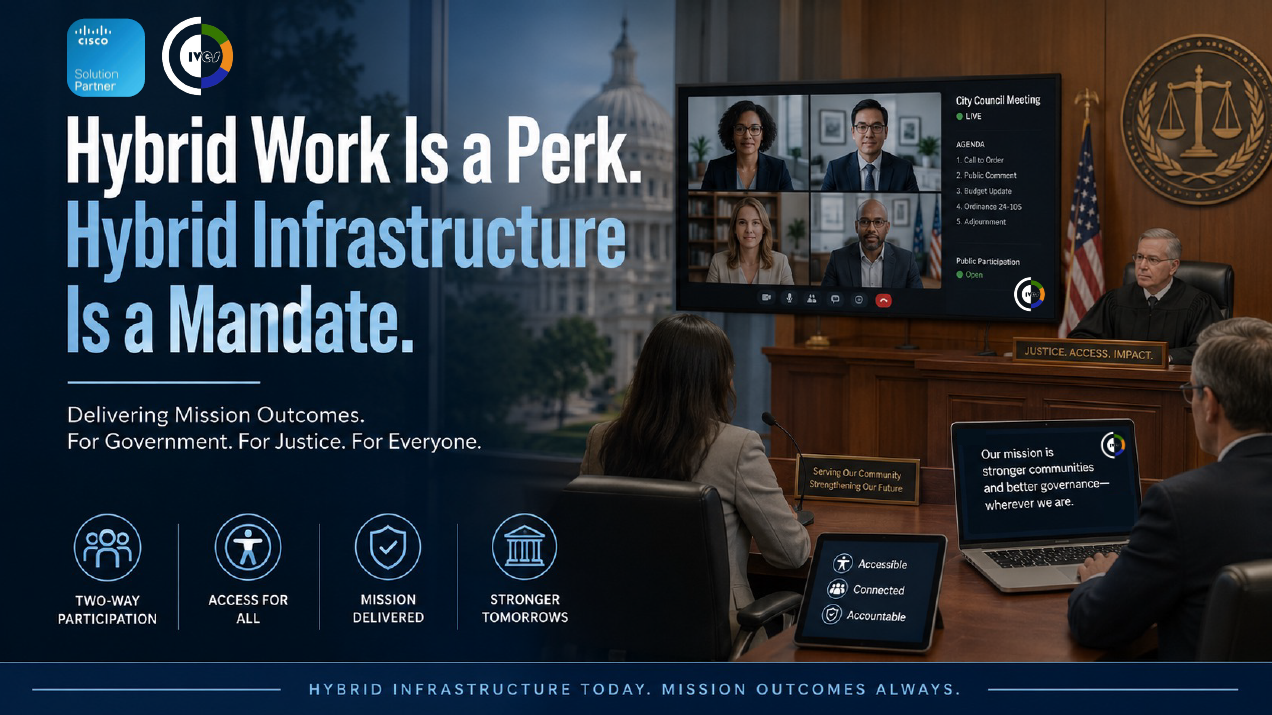
The themes running through InfoComm this year reinforce exactly what Cives has been building toward. The shift from feature-rich tools to trust-ready platforms. The demand for solutions that integrate deeply with operational systems rather than sitting alongside them. The recognition that hybrid collaboration is no longer a workplace trend but a structural shift in how organizations — public and private — actually operate.

For the courts, parliaments, and public agencies that form the backbone of democratic governance, this shift is not optional. Citizens expect digital access. Regulatory frameworks are expanding accessibility and language equity requirements. Legal challenges are exposing the compliance gaps in platforms designed for a different purpose.

The AV and collaboration industry has the infrastructure, the integration expertise, and the channel relationships to serve this market. What it has historically lacked is a platform purpose-built for organizations with constitutional obligations. That platform now exists.

Sovereignty, Data, and the Architecture of Trust

One dimension of the Cives proposition that carries particular weight in the current environment is data sovereignty. The platform can be deployed on-premise, in the cloud, in a hybrid configuration, or as a partner-hosted managed service. Government clients who require local data residency, national jurisdiction compliance, and end-to-end encryption receive it as a native capability, not an afterthought.

In the United States, where state and federal procurement increasingly scrutinizes cloud data residency and foreign technology dependencies, this matters enormously. In Europe, where digital sovereignty is reshaping procurement at every level of government, it is often politically necessary. A platform deployable through a national telco's infrastructure — with public data never leaving national jurisdiction — is not merely commercially attractive; in many tender contexts, it is the only path to award.

For Cisco partners and systems integrators operating in the government and justice verticals, the Cives proposition is direct: your trusted client relationships, your compliance expertise, your integration capabilities — combined with a platform designed from the ground up for governance requirements — equals a public sector digital infrastructure capability that no horizontal OTT provider can replicate.

Built on a Belief: Every Citizen, Equal Access

The name comes from Latin. Cives is the plural of civis — citizen. Not a subject of the state, but an active participant in its governance, endowed with rights, obligations, and voice. That belief is not an aspiration statement. It is a design brief.

Courts for Webex is built to WCAG 2.2 Level AA because a deaf litigant has the same right to a fair hearing as anyone else. GovConnect exists because a rural citizen's claim on public services is no smaller than an urban one. Legislate supports simultaneous interpretation because a non-English-speaking resident governed by California's SB 707 has the same right to understand and address their local government as a native speaker. Every product decision Cives makes flows from the same conviction: the essence of democracy is not merely the ability to vote — it is the ability to participate.

A Market at the Scale of Democratic Society

The addressable market that Cives operates in — govtech, smart courts, civic collaboration, public sector digital infrastructure — is one of the largest and fastest-growing in the technology industry, fuelled by a global wave of public sector digitalisation that shows no sign of slowing.

NextGenerationEU and national recovery plans are channeling unprecedented capital into digital public infrastructure across Europe. Federal and state modernisation programs are doing the same across the Americas. Vision 2030 agendas across the Gulf and Smart Nation strategies throughout APAC are accelerating the same transformation. Every one of those investment programs eventually reaches the same question: what platform do public institutions actually operate on?

Cives is already the answer for 42 governments. The opportunity ahead is orders of magnitude larger.

The Road from Las Vegas

InfoComm 2026 will generate headlines about AI, immersive experiences, and the next generation of meeting room technology. All of it matters. But the most consequential shift in the collaboration industry is not happening on a show floor. It is happening in courtrooms, council chambers, parliamentary halls, and public service offices around the world — places where the stakes are not productivity metrics but democratic legitimacy.

The collaboration industry is ready for this market. The regulatory tailwinds are accelerating. The procurement budgets are real and growing. And for the first time, there is a platform that speaks the language these organizations require — not adapted from enterprise tools, but purpose-built from day one for the obligations that come with serving the public.

The institutions that underpin democratic society are being digitized. The question is no longer whether to build the infrastructure that enables them to do so securely, accessibly, and at scale. The question is who will be their partner in that transformation.

Cives has been answering that question for years. The industry is catching up.